Florida Yacht Financing Options in Cape Coral, FL
How yacht financing works in Florida: loan structures, rates, lender types, and the titling and disclosure rules Cape Coral buyers need to know.
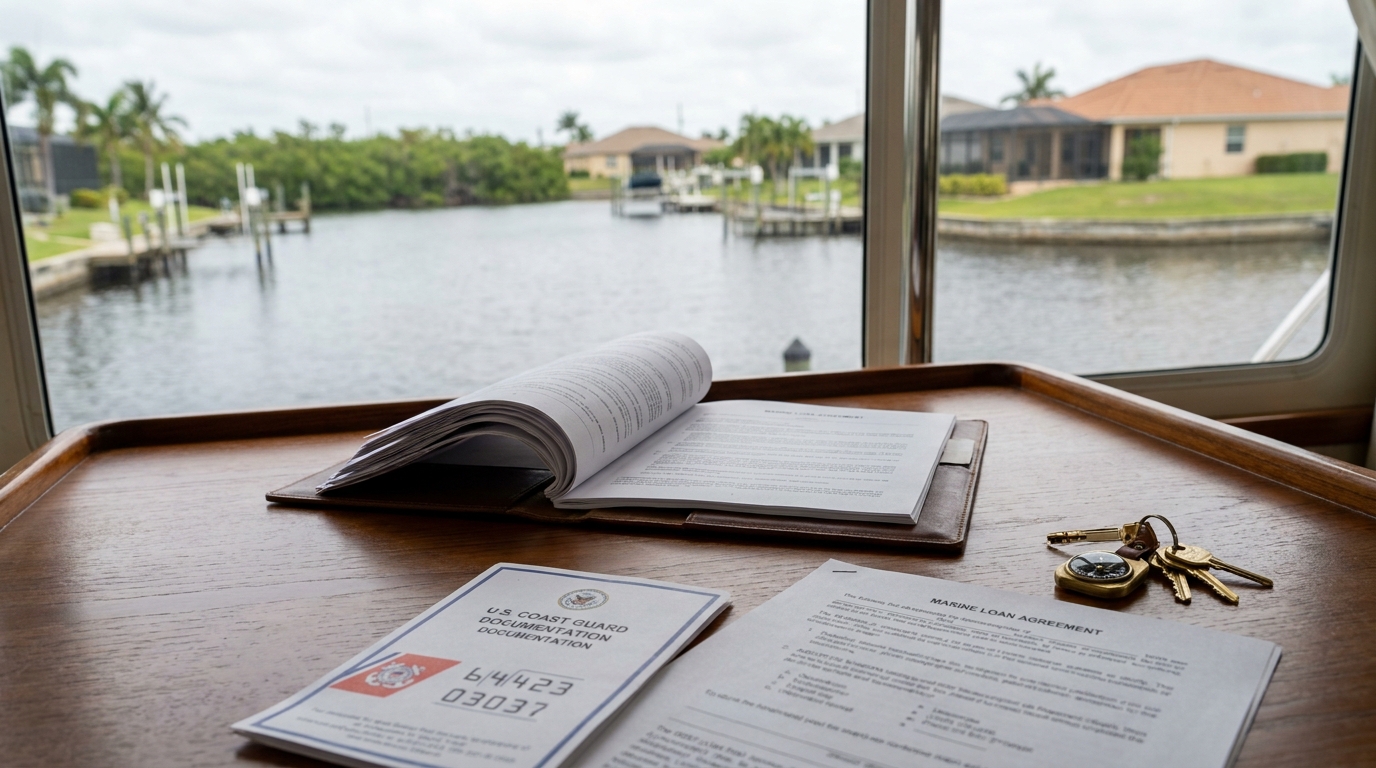
Financing a yacht in Florida typically means securing a marine loan from a specialty marine lender, bank, or credit union, then perfecting that lender's security interest either on the Florida certificate of title (for state-titled vessels) or through a federal preferred ship mortgage (for U.S. Coast Guard-documented vessels). Consumer-purpose loans carry Truth in Lending disclosures under Regulation Z, and Florida requires titling within 30 days of purchase under Chapter 328, Florida Statutes.
For buyers in Cape Coral, the mechanics of yacht financing sit at the intersection of federal lending law, Florida titling statutes, and the practical realities of a saltwater market where hurricane season, insurance requirements, and Gulf-access canal moorage all influence lender underwriting. This guide walks through how the process actually works, what rates and terms look like, and where the paperwork trips buyers up.
How does yacht financing work in Florida?
Yacht financing in Florida works like a secured installment loan: the lender advances funds against the vessel, the buyer signs a promissory note and security agreement, and the lender records its lien either on the Florida certificate of title or as a preferred ship mortgage with the U.S. Coast Guard. Loan terms typically stretch across longer amortizations than auto loans, reflecting the vessel's useful life and value.
At Worldwide Yacht Sales, we routinely coordinate between the buyer, the marine lender, the documentation agent, and the closing attorney so that funding, title work, and delivery land on the same day. That coordination matters more on yacht-class vessels than on smaller boats because the closing usually involves a marine survey, a sea trial, insurance binding, and — for many vessels above the Coast Guard documentation threshold — a decision between state titling and federal documentation.
What are typical yacht loan lender types in Florida?
Florida yacht buyers generally borrow from one of three lender categories: dedicated marine finance companies, national banks with marine lending divisions, and credit unions with recreational lending programs. Marine specialists tend to underwrite the vessel more thoroughly, accept larger loan sizes, and understand Coast Guard documentation. Banks and credit unions may offer sharper rates for well-qualified borrowers on smaller balances.
Dedicated marine lenders are usually the right fit for yachts in the mid-six-figure range and above, because they'll lend on older hulls, foreign-flagged vessels being brought into U.S. registry, and liveaboards — situations most general-purpose lenders decline. For Cape Coral buyers purchasing a Gulf-access vessel to keep on a canal behind the home, a marine lender's familiarity with Florida survey standards and hurricane-season insurance requirements shortens the approval cycle.
What are yacht financing interest rates in Florida in 2026?
Yacht loan interest rates in Florida in 2026 are quoted as an annual percentage rate (APR) and vary primarily with loan size, term length, vessel age, borrower credit profile, and whether the rate is fixed or variable. Larger loan balances and newer vessels generally price better than smaller balances on older hulls. Under Regulation Z, the lender must disclose the APR — not just the note rate — before consummation.
Because rate quotes move with the broader interest-rate environment, the more useful question for a Cape Coral buyer isn't "what's the rate today" but "what drives my rate." The main levers are down payment percentage, term length, and the loan-to-value the lender will support after the marine survey. Buyers who bring 20% down and choose a shorter term consistently see better pricing than those stretching term to minimize the monthly payment.
What loan disclosures must Florida yacht lenders provide?
For consumer-purpose yacht loans, lenders must provide pre-consummation Truth in Lending disclosures under 12 CFR Part 1026 (Regulation Z), including the APR, finance charge, amount financed, total of payments, payment schedule, and any prepayment penalties or balloon payments. These disclosures must be delivered before the borrower signs. Regulation Z does not apply to loans extended primarily for business, commercial, or agricultural purposes — including many charter-vessel loans.
The business-purpose carve-out matters in Florida because a meaningful share of larger yachts are placed into charter programs. If you plan to charter the vessel, the loan may be documented as commercial, which changes both the disclosures you receive and the underwriting standard you face. The Consumer Financial Protection Bureau and federal banking regulators enforce Regulation Z through examinations, consent orders, civil money penalties, and restitution orders.
How is a lender's lien recorded on a Florida yacht?
For a Florida-titled vessel, the lender perfects its security interest by recording the lien directly on the vessel's Florida certificate of title, in compliance with Chapter 328 and § 679.3111, Florida Statutes — not by filing a UCC-1 financing statement. For a U.S. Coast Guard-documented vessel, the lender instead records a preferred ship mortgage under federal maritime law, and the vessel is exempt from Florida titling.
This split is one of the most common sources of closing-day confusion. A yacht that qualifies for Coast Guard documentation (generally, vessels of at least five net tons used in eligible trade) can be titled at either level, and the financing structure often drives the choice. Many marine lenders on larger yachts prefer or require Coast Guard documentation because the preferred ship mortgage carries strong federal priority.
What documents does a Cape Coral yacht buyer need at closing?
A Cape Coral yacht buyer typically needs: proof of ownership (the Manufacturer's Certificate of Origin for a new vessel or the existing certificate of title for a used vessel), a bill of sale, a completed title/registration application, proof of paid sales and discretionary surtax, marine insurance binding, and the executed loan and security documents. Under Chapter 328, a bill of sale alone cannot substitute for title.
Florida requires the title application within 30 days of purchase or of the vessel becoming principally used in Florida, under § 328.03. Miss that window and a mandatory late fee applies under § 328.46(1). No Florida title may be issued unless a receipt evidencing payment of the applicable discretionary sales surtax is filed with the application, per Florida Administrative Code Rule 12A-15.0035 — a detail that catches out-of-state buyers relocating a yacht to Lee County waters.
How do you get approved for a yacht loan in Florida?
Getting approved for a Florida yacht loan generally requires a strong credit profile, verifiable income and liquid reserves, a down payment (often 15–20% or more depending on vessel age), a marine survey acceptable to the lender, and a bindable insurance quote. The lender will also verify title status and confirm whether the vessel will be Florida-titled or Coast Guard-documented before funding.
| Approval Factor | What Lenders Look For |
|---|---|
| Credit profile | Established credit history; higher scores unlock better APRs |
| Down payment | Typically 15–20%+; larger down payments improve terms |
| Liquid reserves | Cash reserves beyond down payment to cover moorage, insurance, maintenance |
| Vessel age & condition | Marine survey; older hulls face tighter loan-to-value |
| Insurance | Bindable coverage meeting lender requirements before funding |
| Title path | Florida title vs. Coast Guard documentation confirmed pre-close |
Why does Cape Coral's market shape the financing conversation?
Cape Coral sits on an extensive network of navigable canals, and Gulf-access properties in areas like the southeast and southwest quadrants routinely include private dockage — which means many local buyers finance a yacht that will be kept on their own seawall rather than a marina slip. Lenders and insurers factor in named-storm exposure during the June–November hurricane season, and buyers who close in spring often have an easier time binding coverage than those closing at peak season.
Worldwide Yacht Sales works with clients across Lee County and beyond, and one recurring theme in customer feedback is comprehensive coordination. That pattern is reflected in the customer feedback we consistently receive. For a buyer new to yacht ownership, that kind of hand-off management is often more valuable than shaving basis points off the rate.
Frequently Asked Questions
Can I finance a yacht purchase in Florida if I live out of state?
Yes. Out-of-state buyers routinely finance Florida-located yachts, and marine lenders are set up for it. The key variables are where the vessel will be principally used and whether it will be Florida-titled, Coast Guard-documented, or titled in your home state. Florida titling is required if the vessel becomes principally used in Florida, with a 30-day application window under § 328.03.
How long does yacht loan approval typically take?
Marine loan pre-approval often takes a few business days once the application, financial statements, and credit authorization are submitted. Final approval and funding depend on the marine survey, sea trial, insurance binding, and title/documentation work, which together typically add another one to three weeks. Coast Guard documentation can extend timelines because federal filings move at their own pace.
Do I owe Florida sales tax if I buy a yacht in Florida?
Florida sales and use tax generally applies to yacht purchases, along with any applicable discretionary sales surtax. Under Florida Administrative Code Rule 12A-15.0035, no Florida title may be issued for a vessel unless a receipt evidencing payment of the applicable discretionary sales surtax is filed with the title application. Specific tax amounts and any caps or exemptions should be confirmed with a Florida tax professional.
Is Coast Guard documentation better than Florida titling for financing?
It depends on the vessel and the lender. Coast Guard documentation creates a federal preferred ship mortgage, which many large-yacht lenders prefer for its strong priority and its usefulness for vessels that travel internationally. Florida titling is simpler for vessels staying in state waters. U.S. Coast Guard-documented vessels are exempt from Florida certificate-of-title requirements under § 328.03.
What happens if I don't title my yacht within 30 days?
A mandatory late fee applies under § 328.46(1), Florida Statutes, when a buyer fails to title and register a vessel within 30 days of purchase. DHSMV and county tax collectors enforce the deadline and can refuse to issue the title until required documentation and tax receipts are provided. The 30-day clock runs from the date of transfer or the date Florida becomes the state of principal use.
Does Regulation Z apply if I'm buying a yacht for charter?
Generally, no. Regulation Z (12 CFR Part 1026) does not apply to credit extended primarily for business, commercial, or agricultural purposes, and loans financing commercial charter vessels or fishing vessels are typically outside its scope. That means the pre-consummation TILA disclosures you'd receive on a personal-use yacht loan aren't required on a charter-purpose loan, and underwriting is structured as commercial credit.
Can a bill of sale alone transfer yacht ownership in Florida?
No. Under Chapter 328, Florida Statutes, proof of ownership must be established via the Manufacturer's Certificate of Origin (MCO) for new vessels or the existing certificate of title for used vessels. A bill of sale alone cannot substitute for title. Buyers relying on a bill of sale without a proper MCO or title will be unable to complete Florida titling and lien recording.
Working with a broker on the financing side
Yacht financing rewards preparation. Buyers who line up marine insurance quotes early, decide on Florida titling versus Coast Guard documentation before the survey, and understand Regulation Z disclosures before signing tend to close on time and at the terms they were quoted. Buyers who improvise on paperwork tend to miss the 30-day titling window and pay a late fee.
Readers in Cape Coral, FL who want the financing, titling, survey, and delivery coordination handled under one roof can reach Worldwide Yacht Sales at https://worldwideyachtsalesinc.com to discuss a specific vessel or start a search. — for a specific transaction, verify current rules with a licensed Florida attorney or maritime specialist.