Catamaran vs Monohull Sailboat: Which Is Right for You?
Catamaran vs monohull sailboat: compare price, performance, comfort, and moorage in Seattle's Puget Sound waters to choose the right hull for your next voyage.
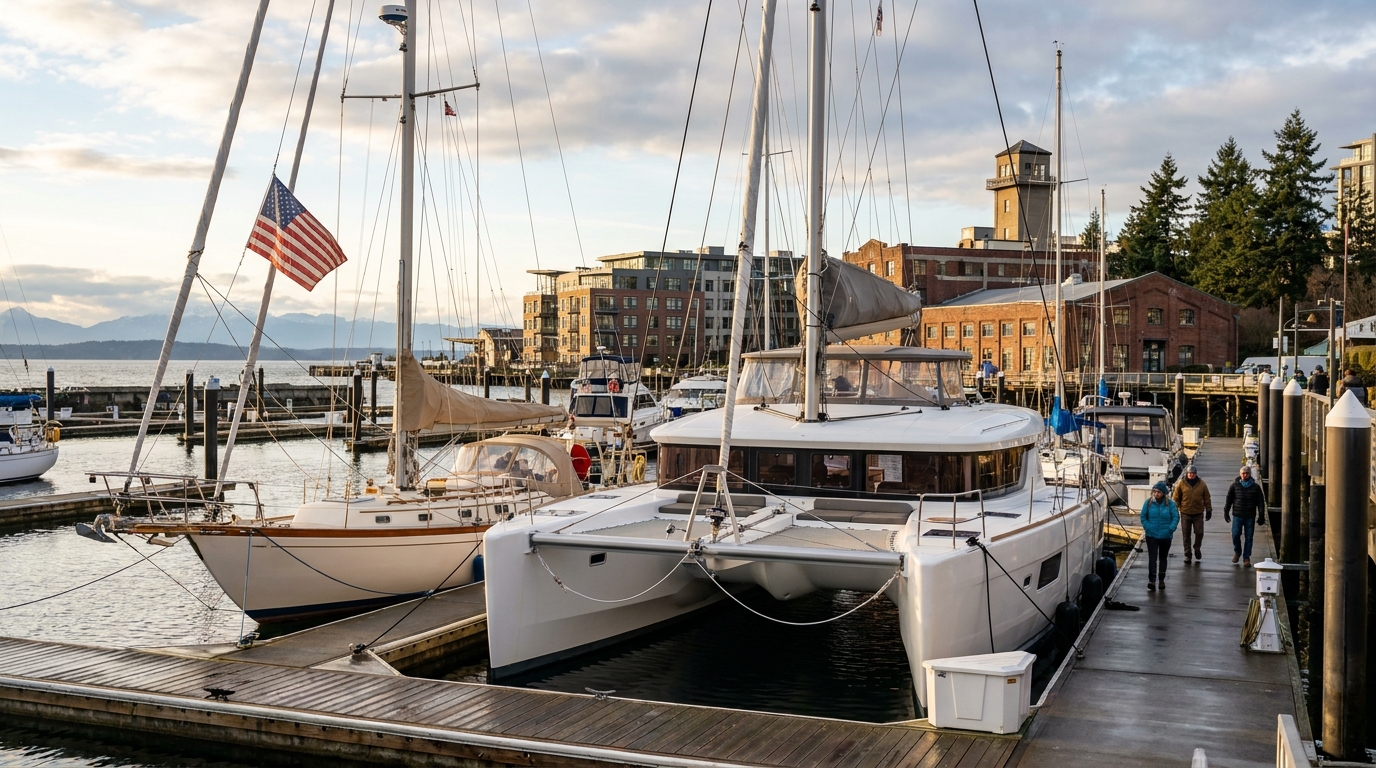
You've decided the next chapter involves sails, salt air, and a home port on Puget Sound. Now comes the fork in the channel: catamaran or monohull? It's the defining question for anyone buying a sailboat in the Pacific Northwest, and the honest answer depends on how you plan to use the boat, where you'll berth it, and what kind of sailing lights you up.
Both hull types can carry you from Shilshole Bay to the San Juans in style. But they sail differently, cost differently, and live differently at the dock. Here's how to think it through.
The Short Answer
If you want maximum space, stability, and downwind speed for family cruising or liveaboard life, a catamaran is hard to beat. If you want sharper upwind performance, lower total cost of ownership, and easy moorage in Seattle's constrained marina environment, a monohull remains the more practical choice. Neither is universally "better" — the right boat is the one that matches your cruising plans and your budget.
Purchase Price: Where Your Dollar Goes Further
Sticker shock is real on both sides, but catamarans sit noticeably higher. Entry-level habitable sailing catamarans start around USD $380,000, with typical new cruising cats landing in the $500,000–$1,000,000+ range and high-end yachts climbing into the millions. Two hulls, duplicated systems, and more structure drive that premium.
Monohulls stretch a budget further at every level. A $200,000 buyer typically walks away with a newer, larger, or better-equipped monohull than an equivalent catamaran. The used monohull market in the Pacific Northwest is also considerably deeper, giving you more inventory to choose from.
Advantage: Monohull.
Interior Space and Comfort at Anchor
This is where catamarans win — decisively. A cruising cat offers roughly 70–80% more usable interior volume than a monohull of the same overall length. You get a wide bridgedeck saloon, private cabins in each hull, and a cockpit built for entertaining. Because cats sail nearly level with minimal heel, meals stay on the table and guests who get queasy tend to stay comfortable.
At anchor in a spot like Sucia Island or Blakely Harbor, that difference is even more pronounced. Cats roll far less than monohulls, which matters when the wind pipes up overnight or a ferry wake rolls through.
Advantage: Catamaran.
Upwind vs Off-Wind Performance
Sailing performance splits cleanly by hull type. Monohulls point higher — typically 30–35° off true wind — while cruising catamarans generally manage 45–55°, meaning they sail 15–30% extra distance when beating to windward. On Puget Sound and the Strait of Juan de Fuca, where prevailing summer winds often push you into upwind work returning to Seattle, that efficiency matters.
Off the wind, the tables flip. A modern 40-foot cruising cat can sustain 8–9 knots on a broad reach, roughly 20–30% faster than a comparable monohull sustaining 6.5–7.5 knots. On the classic downwind run to the San Juans or up to Desolation Sound, cats simply eat miles faster.
Advantage: Split — monohull upwind, catamaran off the wind.
Draft and Anchorage Access
With a shallow draft of roughly 3–4 feet, catamarans slip into coves, sand spits, and gunkholes that monohulls — drawing 5–8 feet — simply can't enter. For exploring the shallower anchorages of the San Juans and Gulf Islands, that flexibility is a genuine cruising advantage.
Advantage: Catamaran.
Moorage in Seattle: The Local Reality Check
Here's where Seattle-specific considerations reshape the conversation. Marina space around Shilshole Bay, Elliott Bay, and Bell Harbor is tight, with waitlists at most facilities. Catamarans pay 1.5–2× standard slip fees because of their wide beam, and slips that can actually accommodate that beam are far scarcer than standard mono berths.
Monohulls fit conventional slips at conventional rates. If you're planning to keep the boat in a Seattle marina rather than trailer or moor it privately, this is a real budget line. Over a decade of ownership, the moorage delta between a cat and a monohull can rival the price of a mid-sized car.
Advantage: Monohull.
Docking, Handling, and Under-Power Maneuvering
Catamarans carry twin auxiliary diesel engines — often 2 × 20 HP on mid-size cruisers up to 2 × 80 HP on larger cats — which lets them pivot in place and dock with precision even in tight fairways. Monohulls typically run a single inboard diesel (6 HP on daysailers, 45 HP on a 40-foot cruiser, 57–80 HP on larger blue-water boats), which demands a bit more skill in a crosswind.
The twin-engine advantage partially offsets the challenge of squeezing a wide beam into a Seattle marina.
Advantage: Catamaran.
Safety, Self-Righting, and Offshore Behavior
Monohulls carry a ballast keel that lets them self-right after a knockdown — a meaningful safety attribute for offshore passages, whether that's a Pacific crossing or a rough transit of the Strait of Juan de Fuca. Catamarans are extremely difficult to capsize thanks to their wide form stability, but if they do go over, they don't self-right.
For most Puget Sound and Inside Passage cruising, this is a low-probability concern. For serious offshore ambitions, many conservative sailors still prefer the recovery behavior of a monohull.
Advantage: Monohull (offshore); effectively a wash for coastal cruising.
Maintenance and Total Cost of Ownership
Two engines mean two fuel systems, two raw-water pumps, two sets of impellers, and duplicated electrical runs. Catamarans cost more to maintain, full stop, and Seattle yard rates reflect that complexity. Monohulls with a single engine and simpler systems tend to carry lower annual maintenance budgets and lower long-term ownership costs.
Advantage: Monohull.
Which Sailboat Is Right for You?
Match the boat to the mission:
- Choose a catamaran if you're planning to liveaboard, cruise with family or guests, prioritize comfort at anchor, or run downwind coastal itineraries to the San Juans and beyond — and your budget accommodates both the purchase price and premium moorage.
- Choose a monohull if you value upwind performance, want more boat for the money, plan to sail solo or as a couple, moor in a standard Seattle slip, or have offshore ambitions where self-righting matters.
Frequently Asked Questions
Is a catamaran or monohull better for cruising the San Juan Islands?
Both work beautifully. Catamarans excel on the downwind legs and offer shallow-draft access to more anchorages. Monohulls handle the upwind return to Seattle more efficiently and cost less to berth at Shilshole or Elliott Bay.
How much more does it cost to moor a catamaran in Seattle?
Expect 1.5–2× standard slip fees due to the wider beam, plus a smaller pool of suitable slips to choose from across local marinas.
Can a beginner handle a catamaran?
Yes. Twin engines make docking more forgiving, and the level sailing platform is easier on new crew. The tradeoff is a higher entry price and a wider boat to think about in tight quarters.
Do catamarans hold their value?
Well-maintained cruising cats have historically held value well because demand from charter operators and liveaboards is strong. Specific resale depends on model, condition, and market timing — a broker can walk you through comps.
Next Steps for Seattle Sailors
Choosing between a catamaran and a monohull is one of those decisions best made after you've stepped aboard a few examples of each and talked through your cruising goals with someone who knows the Pacific Northwest market. Sea trials on Puget Sound reveal things a spec sheet never will — how a boat handles the chop off West Point, how it tacks into a summer westerly, how it feels tied up at Shilshole overnight.
Buyers in Seattle who want experienced guidance through the process can reach Worldwide Yacht Sales at worldwideyachtsalesinc.com. Whether you're leaning toward the space of a catamaran or the sailing feel of a monohull, working with a broker who understands Puget Sound cruising, local moorage realities, and both hull types makes for a smoother voyage from first look to first sail.