
Charter History Impact on Sportfisher Value in Tampa, FL
How prior commercial charter use shapes used sportfisher brokerage valuation in Tampa, FL — the real discount drivers, documentation, and buyer due diligence.
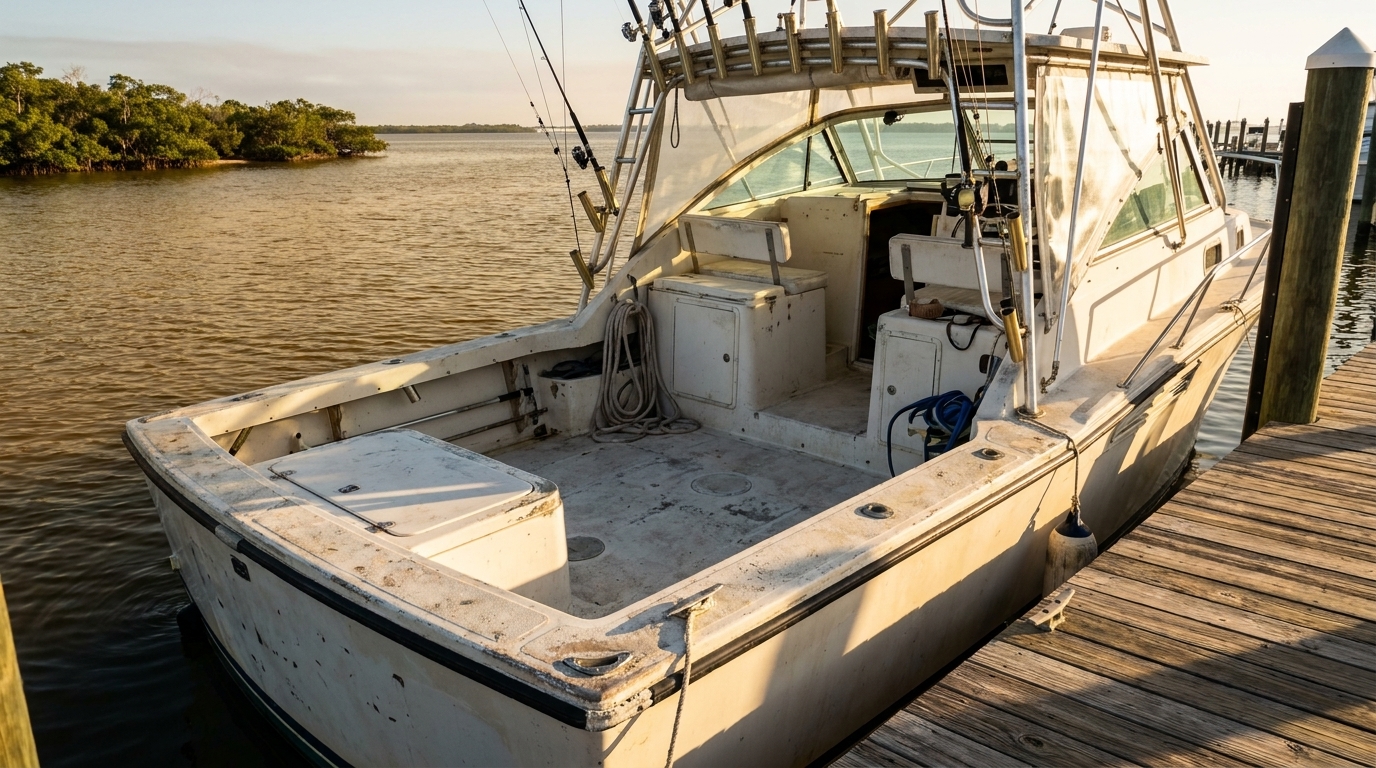
A used sportfisher's prior commercial charter history does not trigger an automatic percentage discount in Tampa's brokerage market — it is treated as a risk-and-evidence question. Well-documented, properly licensed charter service with clean maintenance records can transact near segment comparables, while high engine hours, deferred upkeep, or missing records push offers meaningfully below book, and no statistically supported Tampa-wide charter-use discount is established in available sources.
Does prior charter use automatically lower a sportfisher's value in Tampa?
No. In Tampa's brokerage market, a sportfisher's commercial history is weighed as a risk-and-evidence question rather than a fixed pricing formula, and no statistically supported Tampa-wide charter-use discount percentage is established in available sources. A well-run, fully documented charter vessel can hold near-segment value; an undocumented one gets priced on worst-case assumptions.
What actually moves the number is the quality of the evidence the seller can produce. Engine hour logs, oil-analysis reports, generator and transmission service records, haul-out photos, charter trip logs, and proof of active charter licensure during the operating years all shift the conversation from speculation to math. Worldwide Yacht Sales, a family-owned brokerage that has been serving yacht buyers and sellers for nearly four decades, routinely sees former-charter boats trade competitively when that paper trail is intact.
What charter-specific factors actually move the valuation?
Four factors drive most of the valuation gap on a former-charter sportfisher: total engine and generator hours relative to age, the condition and completeness of maintenance records, visible interior wear from passenger traffic, and whether the vessel's commercial registration and licensing were properly maintained. Each factor can be independently verified by a marine survey and a federal vessel documentation search.
Engine hours are the loudest single input. A six-pack charter working Tampa Bay and the Gulf grounds year-round accumulates hours several times faster than a private recreational boat of the same age, and buyers and lenders price that forward maintenance liability directly into their offers. Interior finishes — upholstery, cockpit sole, head compartments, galley surfaces — show cumulative passenger wear that private-use boats of the same vintage simply do not.
Registration status matters because Florida HSMV classifies commercial-use vessels differently from recreational ones, and federally documented vessels are publicly searchable, meaning a prior commercial-use flag follows the hull. Buyers verifying title history during due diligence will see it, and the valuation conversation starts from there.
How do Tampa Bay conditions and segment data shape the discount?
Tampa Bay's combination of protected inshore water and immediate Gulf of Mexico offshore access makes range, fuel capacity, and seaworthiness material to resale appeal, and the June 1 through November 30 Atlantic hurricane season sharpens buyer scrutiny of storm, flooding, and grounding history. Those local pressures amplify the premium on clean documentation and penalize gaps more heavily than inland markets would.
A former-charter vessel typically trades below the midpoint of its segment band unless records are exceptional.
BoatValue's sportfish index gives segment-level ranges real statistical weight — but those are national ranges, not Tampa closed-sale averages, and any specific hull needs a professional survey plus verified local comparables to value credibly.
How does charter use interact with age-based depreciation?
Boats depreciate on an S-curve — roughly 10–15% in year one, around 20% by year five, and 30–50% by year ten per BoatUS, with accelerated depreciation in later years often tied to insurance restrictions at 20-, 25-, or 30-year vessel age milestones. Charter use accelerates the practical equivalent of that curve by compressing hours and wear into fewer calendar years, so a five-year-old charter boat often shows closer to a ten-year-old private boat's condition profile.
Age also triggers structural valuation cliffs independent of hours. Insurance coverage restrictions commonly kick in at the 20-, 25-, and 30-year vessel marks, per BoatUS, which can shrink the buyer pool and compress asking-to-closed-sale ratios on older former-charter hulls regardless of how well they were maintained.
What should Tampa buyers and sellers of former-charter sportfishers do?
| Segment | Typical Value Band (National) | 5-Year Retention |
|---|---|---|
| Express Sportfish 35–42 ft | $250K–$600K | 50–60% |
| Convertible 38–46 ft | $400K–$1.2M | 50–60% |
| Convertible 46–55 ft | $700K–$2M | 50–60% |
| Center Console (fish) 36–42 ft | $400K–$1M | 55–65% |
| Walkaround 32–38 ft | $250K–$500K | 55–65% |
Ranges above are national segment estimates from BoatValue as of mid-2026, not Tampa closed-sale figures. Sellers should assemble a complete documentation package — captain's logs, charter trip records, engine and generator hour histories, oil analyses, haul-out and bottom-paint records, hurricane haul-out proof, and prior survey reports — before listing. Buyers should commission an independent marine survey, pull the vessel's federal documentation history, and verify that Florida HSMV titling and any commercial registration classifications are clean and transferable.
Captain licenses, federal OUPV (six-pack) credentials, and FWC fishing permits do not transfer with the vessel at sale, so a buyer intending to continue charter operations should budget separately for their own licensing. Worldwide Yacht Sales, which describes its seller approach as providing top-tier marketing for every listing, works both sides of these transactions and can structure a documentation package that answers the questions buyers in this market actually ask.
Frequently Asked Questions
Is there a standard percentage discount for a former-charter sportfisher in Tampa?
No. No statistically supported Tampa-specific charter-use discount percentage is established in available sources. The valuation gap depends on documented engine hours, maintenance records, interior condition, licensing history, and comparable closed sales for the specific make, model, and length. A professional marine survey and verified comps are the only credible path to a defensible number on any individual hull.
What documents should a seller gather before listing a former-charter sportfisher?
Sellers should assemble engine and generator hour logs, oil-analysis results, scheduled-maintenance records, haul-out and bottom-paint history, prior marine survey reports, charter trip logs, proof of active charter licensure during operating years, federal vessel documentation, and Florida HSMV titling records. A complete package shifts buyer offers upward because it replaces worst-case assumptions with verified fact.
Do captain licenses or fishing permits transfer with the boat when sold?
No. Captain credentials, the federal OUPV six-pack license, and FWC fishing or charter permits do not automatically transfer with the vessel. A buyer who intends to continue charter operations must independently obtain the applicable charter licenses and any required federal credentials, and should budget time and cost for that process separately from the vessel purchase.
How much do engine hours matter on a Tampa charter sportfisher?
Engine hours are typically the single largest driver of the valuation adjustment. A charter boat working Tampa Bay and Gulf grounds year-round accumulates hours far faster than a private recreational vessel of the same age, and buyers price forward maintenance liability — rebuilds, injectors, transmissions, running gear — directly into their offers. Documented oil analyses and service records partially offset high-hour penalties by proving the hours were run well.
Does Florida hurricane season affect used sportfisher valuations?
Yes. The Atlantic hurricane season runs June 1 through November 30, and Tampa buyers scrutinize storm, flooding, and grounding history closely. A former-charter vessel with documented hurricane haul-out records, no insurance claims, and clean survey history commands better pricing than one with gaps. Storm history can also affect insurance availability and premium, which indirectly compresses offers on vessels with questionable records.
What happens to valuation when a sportfisher crosses the 20- or 25-year age mark?
Insurance coverage restrictions commonly apply at 20-, 25-, and 30-year vessel age milestones per BoatUS, which shrinks the eligible buyer pool and tends to compress closing prices regardless of condition. A well-maintained former-charter hull can still trade in that market, but financing and insurance become materially harder to arrange, which the asking price has to reflect.
Working with a Tampa brokerage on a former-charter sportfisher
Valuing a used sportfisher with commercial history is a documentation exercise more than a pricing exercise. The vessels that trade well in Tampa are the ones whose records answer the hard questions before a buyer asks them, and the ones that stall are almost always the ones with gaps a surveyor has to guess around. Readers in Tampa, FL who want this handled professionally — whether listing a former-charter sportfisher or evaluating one on the market — can reach Worldwide Yacht Sales at (727) 346-8229 or https://worldwideyachtsalesinc.com to get started.