Motor Yacht vs Sailing Yacht in Tampa Bay: Myths Busted
Tampa Bay bridge clearances, wind, and marina realities decide the motor vs sailing yacht question. A myth-busting 2026 buyer's guide.
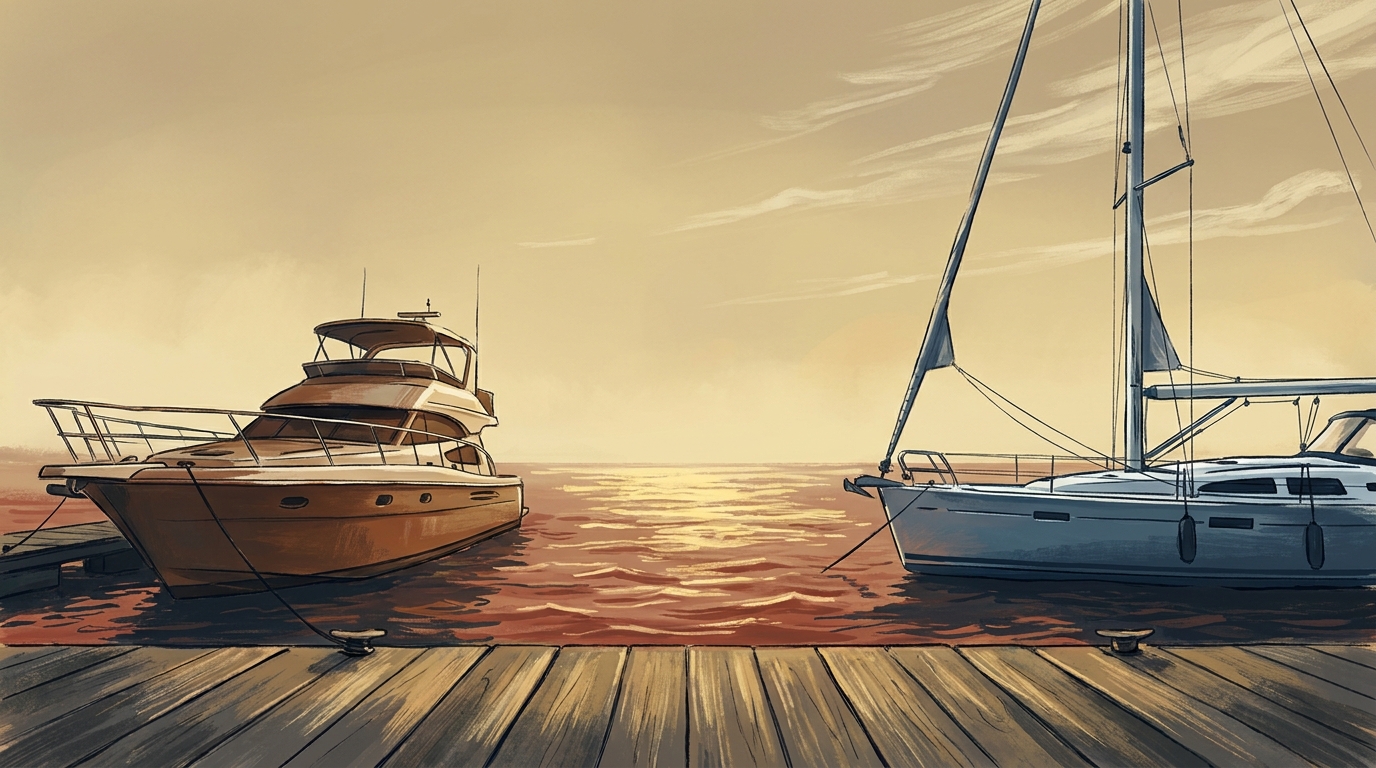
The common belief is that a sailing yacht is the romantic, economical choice and a motor yacht is the extravagant one — so Tampa Bay buyers who want to be smart with their money should lean toward sail. That framing is wrong for this market. For most buyers keeping a boat on Tampa Bay, a motor yacht is the more practical vessel because local bridge clearances, light average winds, and the mix of shallow coastal anchorages work against a tall-masted sailboat and in favor of a shallow-draft powerboat.
None of that makes sailing a bad choice — it makes it a specific choice. The myths worth busting are the ones that lead buyers to the wrong boat for the water they actually run.
Myth 1: "A sailing yacht is always cheaper to run — so it's the smarter buy"
Fuel economy favors the sailboat, but total operating cost is a wash that depends entirely on use. A Beneteau Oceanis 40.1 carries a 52-gallon fuel tank and sips from a 45-hp auxiliary diesel; a Sea Ray Sundancer 370 Sterndrive carries 250 gallons and burns through them with twin 430-hp petrol engines (860 hp combined). Sail wins on fuel. The sailboat pays it back in rigging, standing and running rigging inspections, sail replacement, and sail-handling hardware.
The deeper problem is that fuel savings only materialize when you actually sail. Tampa's annual average wind speed is approximately 3.1 mph per the Florida Climate Center, though calm summer months can see even lighter conditions. Buyers who imagine quiet afternoons under canvas often end up motoring on the auxiliary, which erases most of the economy argument during the hottest, calmest months of the Tampa Bay season. Spring months, by contrast, bring stronger afternoon sea breezes, so the sailing window is real — it's just narrower and more seasonal than the brochure photos suggest.
Myth 2: "Bridge clearance is a minor logistics issue"
Bridge clearance is the single most restrictive factor for a sailboat on Tampa Bay, and most buyers underestimate it until the survey. The Beneteau Oceanis 40.1 carries a 60 ft 2 in air draft. Almost every drawbridge and fixed span inside the bay sits well below that number when closed.
| Bridge | Closed clearance |
|---|---|
| Sunshine Skyway (fixed main span) | 175 ft |
| Johns Pass drawbridge | 28 ft |
| Pinellas Bayway Structure C (Tierra Verde) | 25 ft |
| Corey Causeway drawbridge | 23 ft |
| Treasure Island Causeway drawbridge | 21 ft |
| Walsingham Road (Indian Rocks) drawbridge | 21 ft |
| Park Boulevard drawbridge | 20 ft |
| Shore Acres canal fixed spans | 8–13 ft |
Every other listed structure requires a drawbridge opening on schedule or signal, and the fixed spans in Shore Acres — as low as 8 feet on the old bridges and about 13 feet on the new — cannot clear the Beneteau's rig at any tide. The Sea Ray Sundancer 370 has a shallow powerboat profile that clears every one of these spans closed. That difference reshapes which marinas, which canal homes, and which routes are even available.
Brokers at Worldwide Yacht Sales work through this analysis with buyers before a vessel is chosen — walking through intended cruising grounds, home dock access, and the specific bridges on the route — because a sailboat that cannot reach the owner's dock is not a boat, it is a problem.
Myth 3: "Sailboat water or powerboat water — it only matters to the real-estate agent"
It matters to the yacht buyer first. In Tampa Bay, waterfront property is sorted into "sailboat water" (no fixed bridge between the dock and open water) and "powerboat water" (a fixed-bridge height limit between the dock and the bay). Venetian Isles has wide canals with no bridge between the dock and the bay, and owners there keep 35-foot boats behind their homes. Shore Acres, with those 8–13 ft fixed spans, is powerboat water and nothing else.
The Sundancer's 3 ft 6 in draft and low profile fit both categories. The Beneteau's 60 ft 2 in air draft — and 5 ft 6 in minimum (7 ft 5 in maximum) keel draft — needs sailboat water, period. A buyer who falls in love with a sailing yacht and then buys a home on a fixed-bridge canal has made two expensive decisions that fight each other.
Myth 4: "Schedule flexibility and docking skill are the same for both"
Schedule predictability — leaving the dock on time and arriving at Egmont Key when you said you would — belongs to the motor yacht in this comparison. Twin high-horsepower engines run on demand; a sailing passage depends on wind direction, strength, sail plan, sea state, and crew skill. On a 3-mph afternoon, a sailboat under sail is barely making way; the Sundancer is cruising on plan.
Docking is the other half of the skill question. Twin engines plus a joystick on the Sundancer make low-speed maneuvering in a tight marina slip approachable in a season rather than years. A 42-foot sailboat with a single auxiliary and a long keel requires more learned technique and more deliberate practice, particularly in the crosswinds that funnel through Tampa Bay marina basins in spring.
Myth 5: "The sailboat sleeps more and lives bigger"
The sailing yacht is longer (42 ft 3 in) and beamier (13 ft 9 in) than the Sundancer (37 ft 8 in long, 12 ft beam), and it carries more water — 87 gallons versus 46 — which does suit longer stays aboard. But the Sundancer offers four cabins to the Beneteau's two-, three-, or four-cabin layouts, and the motor yacht's climate-controlled interior matters more than brochure beam when August humidity settles over the bay. Buyers imagining weekend guests often find the powerboat's cabin count and air conditioning more useful than the sailboat's larger water tank.
What should Tampa Bay buyers actually weigh in 2026?
Twin-engine joystick controls shorten the docking learning curve, the shallow draft of a boat like the Sundancer opens up more coastal anchorages, and a low air draft removes bridge planning from almost every route. Those are the practical reasons a motor yacht wins most Tampa Bay use cases. A sailing yacht wins when the buyer genuinely wants to sail — not to own a sailboat, but to sail one — and has sailboat-water dock access and the patience for a schedule the wind writes.
Worldwide Yacht Sales, a family-owned brokerage founded in 1989, has worked both sides of this question for close to four decades and recommends buyers charter each type on the bay before committing. One recent buyer summed up that fit-first process this way:
"I couldn’t be happier with the entire staff. They used all their resources to help me get into the Yellowfin I’ve always dreamt of!!!" — 5★ · Brad, Mar 2026
Frequently asked questions
Can a sailing yacht with a 60-foot mast reach open water from most Tampa Bay canals?
No. Most Tampa Bay canal exits route under drawbridges with 20–28 ft closed clearance or fixed spans as low as 8–13 ft in Shore Acres. A 60 ft 2 in air draft like the Beneteau Oceanis 40.1 requires a drawbridge opening to leave, and cannot pass fixed spans at any tide — which is why "sailboat water" dock access matters so much.
Is a motor yacht really cheaper overall, or just easier?
Easier, not cheaper. A motor yacht like the Sea Ray Sundancer 370 burns substantially more fuel from its 250-gallon tank than a sailing yacht does from its 52-gallon tank and 45-hp auxiliary. The sailboat pays that back in rigging, sails, and sail-handling maintenance. Total cost depends on use; schedule flexibility and docking ease are where the motor yacht genuinely leads.
How much wind does Tampa Bay actually get for sailing?
Less than most buyers expect. The Florida Climate Center records Tampa's annual average wind speed at approximately 3.1 mph; calm summer months can see lighter conditions, while spring months tend to bring stronger afternoon sea breezes. Afternoon sea breezes in spring and summer can be stronger and gustier, but reliable sailing wind is seasonal rather than year-round.
What does a slip cost for a boat this size on Tampa Bay?
Slip pricing on Tampa Bay varies by location, amenities, and waitlist, so quotes should be confirmed directly with the facility. Marina pricing varies by location, amenities, and waitlist, so quotes should be confirmed directly with the facility.
Does the Sunshine Skyway Bridge limit sailing yachts leaving Tampa Bay?
The clearance constraints inside Tampa Bay come from the drawbridges and fixed canal bridges, not from the Skyway.
Which boat is easier to learn to dock?
The motor yacht, clearly. The Sea Ray Sundancer 370's twin 430-hp engines and joystick piloting let a new owner manage close-quarters marina maneuvering within a season. A 42-foot single-screw sailing yacht requires more practiced technique for backing, pivoting, and holding against crosswinds, and most buyers need several seasons to feel confident in tight slips.
The bottom line
Tampa Bay rewards the boat that matches its specific water. For buyers who want predictable schedules, air-conditioned comfort, access to shallow anchorages, and compatibility with most waterfront homes on the bay, a motor yacht is the practical answer. For buyers with sailboat-water dock access, genuine interest in learning to sail, and tolerance for wind-dependent planning, a sailing yacht delivers an experience a powerboat cannot. Readers who want to work through the specific tradeoffs for their intended cruising ground and home dock can reach Worldwide Yacht Sales at (727) 346-8229 or https://worldwideyachtsalesinc.com to start that conversation.