New vs Used Yacht in Tampa, FL: The Better Buy in 2026
A data-backed 2026 buyer's guide comparing new and used yachts in Tampa, FL — depreciation, survey costs, tax caps, and total ownership math.
For most Tampa buyers in 2026, a well-surveyed late-model used yacht delivers the strongest capability-per-dollar, while a new build makes financial sense primarily for buyers who plan to keep the boat 7+ years, want specific customization, or need warranty-backed systems for extended Gulf cruising. Current Tampa Bay brokerage data shows the median sale price sitting near $200,000, with the $100,000–$250,000 band accounting for the largest share of transactions — a market where disciplined negotiation currently favors buyers.
What does the current Tampa yacht market actually look like in 2026?
That combination — rising median prices alongside rising price reductions — signals a segmented market. Well-priced, well-maintained vessels move; overpriced or tired inventory sits. For a Tampa buyer weighing new against used, this is the most important context: the negotiating floor on used yachts has softened, while new-build pricing has not.
How do new and used yachts compare on price and equipment in Tampa?
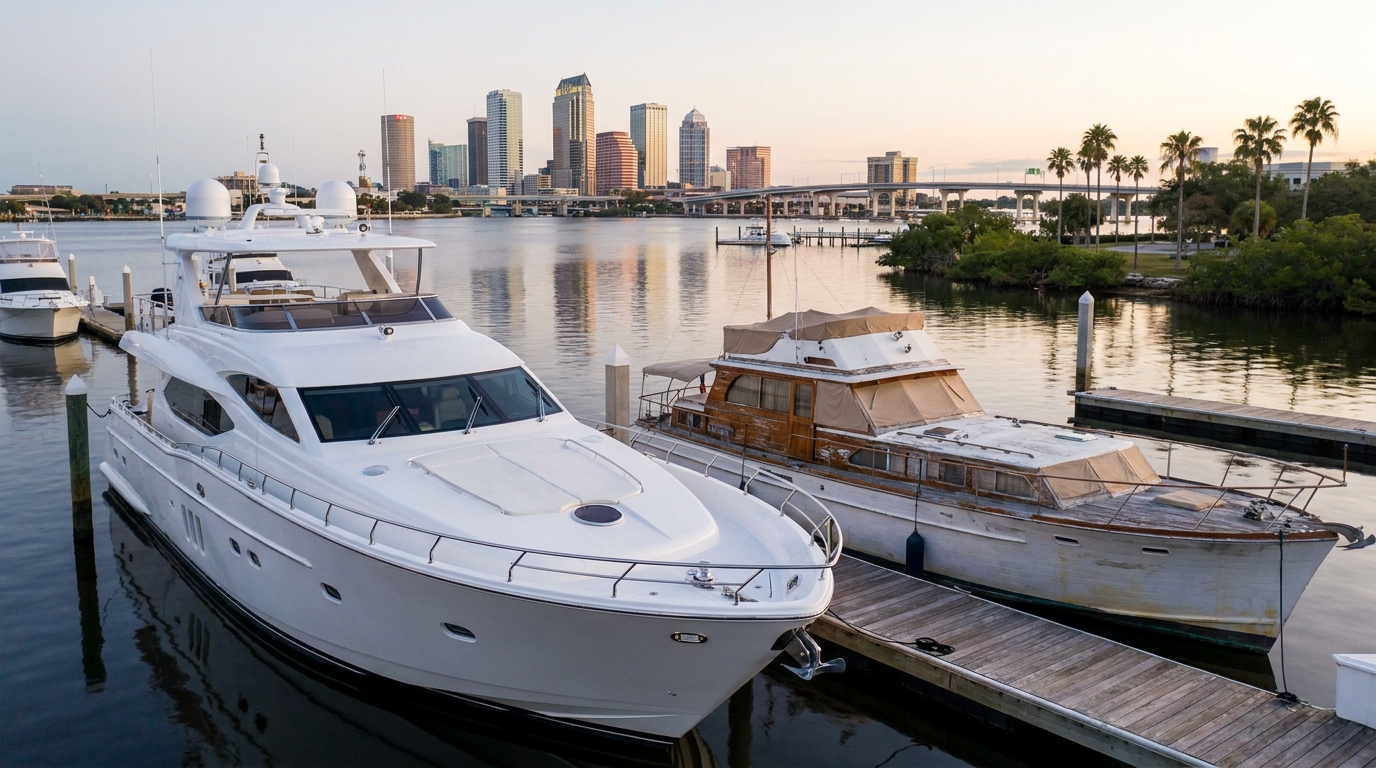
Used yachts in Tampa Bay typically deliver more length, more equipment, and more included electronics per dollar than new builds. A 30–45 foot used cruising yacht generally falls in the $100,000–$500,000 range, while 45–80 foot used yachts span roughly $500,000 to $4 million. New yachts in comparable size classes usually start several hundred thousand dollars higher and can run into the millions once customization, electronics, and delivery are specified.
The tradeoff is not simply sticker price. New buyers pay a premium for warranty coverage, current emissions and safety technology, and layout customization. Used buyers accept survey risk, potential deferred maintenance, and electronics obsolescence in exchange for substantially more boat per dollar.
| Segment | Typical Tampa Price Range | Primary Tradeoff |
|---|---|---|
| Used, 30–45 ft | $100,000–$500,000 | Largest transaction band; strong selection, survey-dependent |
| Used, 45–80 ft | $500,000–$4 million | Wide variation by refit history, brand, and equipment |
| New, common cruising sizes | Several hundred thousand to several million | Warranty and customization premium |
| Large used yachts, 79–98 ft | ~$4 million average asking | Condition and refit exposure drive true cost |
| Superyachts, 213 ft+ | ~$104.5 million average asking | Specialist market; separate advisory required |
What are the Florida tax and registration costs Tampa buyers should model?
Florida applies a 6% sales or use tax on boat purchases, but the tax collected on a single vessel sale is capped at $18,000 under Florida law. Registration fees range from about $5.50 for vessels under 12 feet to $189.75 for vessels 110 feet or longer, and titling and registration must generally be completed within 30 days of purchase through a county tax collector or authorized agency.
The $18,000 tax cap materially compresses the tax gap between a $300,000 boat and a $3 million boat, which changes the new-versus-used calculus at the upper end: on a $2 million yacht, the effective tax rate is under 1%, not 6%. Nonresidents may generally operate a properly registered home-state vessel in Florida for up to 90 days before Florida registration steps may be required. Because trade-in treatment, delivery location, financing, and residency all affect the final bill, buyers should obtain a transaction-specific determination from the Florida Department of Revenue or a qualified maritime tax adviser. Worldwide Yacht Sales, based in Treasure Island just across the bay from Tampa, routinely coordinates these steps as part of a purchase.
How does Tampa's climate change the depreciation and ownership math?
Tampa's climate compresses used-yacht values faster than cooler markets because sun, salt, humidity, and hurricane exposure accelerate wear on gelcoat, electronics, canvas, and mechanical systems. The Atlantic hurricane season runs June 1 through November 30, and storm risk directly affects insurance availability, deductibles, and required haul-out plans — costs that apply to new and used vessels alike.
For used buyers, this is where survey rigor pays for itself. A thorough pre-purchase survey should scrutinize evidence of prior hurricane damage, water intrusion, corrosion, electrical repairs, and undocumented insurance work. For new buyers, the warranty offsets some early-ownership risk, but replacement parts and warranty service can still be delayed after major storms. Every ownership budget should include a specific storm-storage plan — haul-out, dry stack, protected slip, or seasonal relocation — because that line item can shift annual cost by thousands.
Where does new pay off, and where does used win in Tampa Bay?
New pays off when the buyer plans to keep the yacht seven or more years, wants specific layout or propulsion choices, needs the latest emissions and safety systems for offshore or charter use, or values a manufacturer warranty on complex systems. Used wins for buyers focused on capability-per-dollar, buyers who want to avoid the steepest early depreciation curve, and buyers who can absorb a disciplined refit budget in exchange for a substantially larger or better-equipped boat.
A frequently overlooked middle option is the late-model used yacht — typically two to five years old — which combines modern design and systems with the initial depreciation already absorbed by the first owner. In Tampa's current market, this is often the strongest financial position, particularly for buyers targeting the $250,000–$1 million range where selection is deepest.
What should Tampa buyers look for in a yacht sales company?
Buyers should prioritize brokers with documented local market knowledge, transparent communication, verified transaction history, and the ability to coordinate survey, financing, documentation, and logistics as a single workflow. Tampa Bay's geography — draft-sensitive channels, bridge clearances, manatee zones, and Gulf exposure — rewards a broker who can match vessel specifications to the buyer's actual cruising plan, not just close a listing.
Worldwide Yacht Sales holds a 4.8-star rating across 28 Google reviews as of May 2026, with customers consistently citing responsiveness, honesty, and end-to-end handling of financing, inspection, and transportation. One recent reviewer described the process as "informative, patient, no pressure," including shipping a Florida-purchased boat to an out-of-state buyer — a pattern that matters in Tampa, where a meaningful share of buyers arrive during the winter snowbird months and finalize purchases remotely.
Frequently asked questions
Is a new or used yacht cheaper to insure in Tampa?
Insurance cost depends more on hull value, construction, age, cruising area, storm plan, and operator experience than on new-versus-used status alone. Newer yachts often qualify for broader coverage terms, while older yachts may face higher deductibles or named-storm exclusions in Tampa Bay. Buyers should obtain quotes on specific candidate vessels before finalizing a purchase decision, because premiums vary substantially by underwriter.
How much should a Tampa buyer budget for a pre-purchase survey?
Survey costs vary by vessel length, complexity, and scope, but Tampa buyers should generally budget for a hull and mechanical survey plus a sea trial and, on larger yachts, an engine survey and oil analysis. Skipping any component to save cost is the most common expensive mistake in used-yacht purchases, because undetected issues routinely exceed the entire survey fee many times over.
What is Florida's sales tax cap on a yacht purchase?
Florida's boat sales or use tax is generally 6%, but the tax collected on a single vessel sale is capped at $18,000 under Florida law. County discretionary surtax rules and exemptions can apply, and tax treatment depends on delivery location, residency, and trade-in structure. Buyers should confirm the specific figure with the Florida Department of Revenue or a qualified maritime tax adviser before closing.
Do I need a boating license to operate a yacht I buy in Tampa?
Florida does not issue a conventional boating license. Instead, any person born on or after January 1, 1988 must generally carry a Boating Safety Education Identification Card when operating a motorized vessel of 10 horsepower or more. The card is obtained through an approved boating-safety course. Additional rules can apply to minors, charter operations, and larger or faster vessels.
How long do I have to register a newly purchased yacht in Florida?
Most motorized vessels operated, used, or stored on Florida waters must be titled and registered through the state system generally within 30 days of purchase or of bringing the vessel into Florida as the state of principal use. Registration is handled through a county tax collector or authorized tag agency, with fees ranging from about $5.50 to $189.75 based on vessel length.
When is the best time of year to buy a yacht in Tampa?
Winter and early spring generally offer the most comfortable sea-trial conditions and the strongest transient buyer traffic in Tampa Bay, while late summer and early fall can create motivated sellers ahead of hurricane season and storm-preparation deadlines. The current market's rising number of price reductions suggests that patient buyers negotiating on well-documented listings have leverage across the calendar, not only in traditional off-peak windows.
The bottom line for Tampa buyers
In Tampa's 2026 market, used yachts — particularly late-model used in the $250,000–$1 million range — offer the strongest capability-per-dollar for most buyers, provided the survey is rigorous and the ownership budget includes storm storage, insurance, and a realistic refit reserve. New builds remain the right answer for long-hold buyers who value customization, warranty coverage, and current-generation systems, and Florida's $18,000 sales tax cap narrows the tax gap significantly at higher price points. Buyers in Tampa, FL who want the new-versus-used analysis run against specific candidate vessels can reach Worldwide Yacht Sales at https://worldwideyachtsalesinc.com to work through survey, financing, and documentation as a single process.