Used Boats in Saint Petersburg, FL: Inspect First
A pre-purchase inspection checklist for used boats in Saint Petersburg, FL — what to check, when waiting costs you, and how to buy with confidence in 2026.
Buying a used boat in Saint Petersburg, FL starts with a disciplined pre-purchase inspection: verify ownership documents, examine the hull and structural areas, evaluate engines and onboard systems, and conduct a sea trial before any money changes hands. Waiting to inspect — or skipping steps because the boat looks clean — is where buyers lose money, because Florida's Gulf Coast climate hides corrosion, water intrusion, and storm damage behind fresh wax and new upholstery.
What should buyers inspect first on a used boat in Saint Petersburg, FL?
Start with paperwork, then hull, then power, then systems, then sea trial — in that order. Confirm the seller holds a clean title and current registration before touching the boat. Walk the hull for stress cracks, blistering, and transom flex. Pull engine covers to check for salt corrosion and oil condition. Then run every system under load on the water.
That sequence matters because each stage can disqualify the boat before you spend time or money on the next. A boat with a clouded title or a soft transom is not worth a sea trial. Worldwide Yacht Sales, a family-owned brokerage based in Treasure Island, handles transactions from consultation through delivery and routinely guides buyers through this exact progression.
Why does waiting to inspect cost Saint Petersburg buyers money?
In a warm coastal climate, delay compounds. Every week a hidden cooling issue, soft stringer, or corroded wiring harness goes undetected is another week of saltwater exposure and heat cycling. Buyers who defer a thorough inspection until after closing routinely discover repair bills that exceed what a professional survey would have cost — and lose any negotiating leverage the moment the title transfers.
The cost-of-waiting curve on the Gulf Coast is steeper than inland markets for three reasons. Saltwater accelerates electrolysis on through-hulls, trim tabs, and outboard lower units. Humidity drives mildew and electrical corrosion into every unsealed cavity. And hurricane season — June through November — means some used inventory has lived through storm surge or prolonged submersion that only shows up months later as delamination or ignition failure.
Delay also shrinks the inspection options themselves. Florida's vessel titling rules generally require title and registration transfers within 30 days of purchase, so buyers who close before fully inspecting have a narrow window before the boat is legally — and financially — theirs to deal with.
What documents should Saint Petersburg buyers verify before anything else?
Verify the title, the hull identification number (HIN), current Florida registration, and any outstanding liens before scheduling a physical inspection. The HIN on the transom must match the title and registration exactly. Ask for maintenance records, prior survey reports, and documentation of any insurance claims — particularly for named-storm damage.
Florida administers vessel titling and registration through the Department of Highway Safety and Motor Vehicles and county tax collectors. A buyer should confirm the applicable process with those agencies before closing, especially for documented vessels, which follow a separate U.S. Coast Guard National Vessel Documentation Center track. A Florida boat purchase may also be subject to state sales tax and applicable local surtax; buyers should verify the current tax treatment directly with the Florida Department of Revenue rather than relying on a seller's estimate.
What hull and structural issues matter most on Gulf Coast boats?
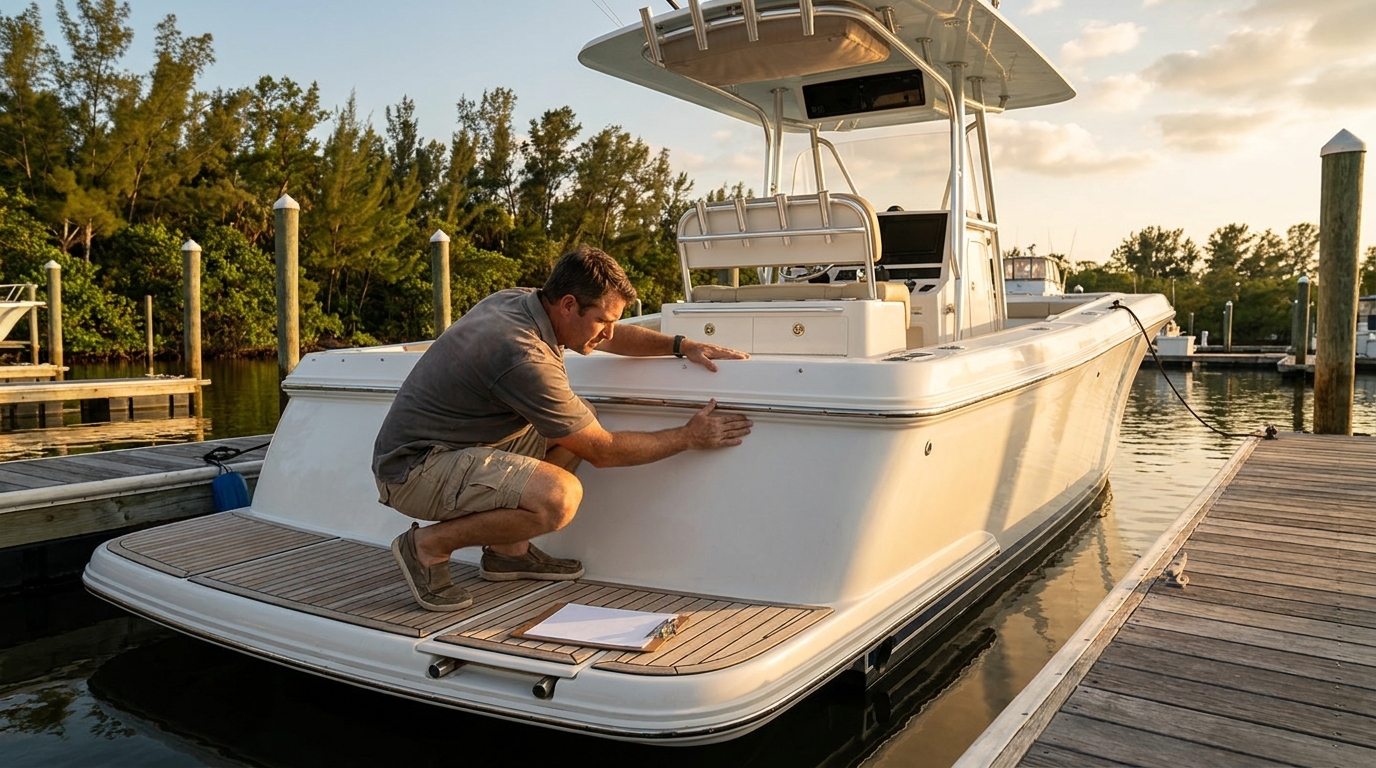
Focus on the transom, stringers, bulkheads, and below-waterline hardware. Press the transom firmly around the engine mounts — any flex or spongy response points to core saturation. Tap the hull with a plastic mallet listening for dull spots that indicate delamination. Inspect through-hulls, trim tabs, and anodes for galvanic corrosion, which runs faster in warm, saline coastal waters.
On trailered boats, check the keel, chines, and strakes for impact damage from launch ramps. On boats kept in slips, look at the bootstripe and running gear for growth patterns that reveal how the boat actually sat in the water — a listed waterline often signals an imbalance or waterlogged compartment the seller hasn't disclosed.
How should buyers evaluate engines and systems before the sea trial?
Dockside, pull engine covers and inspect for salt residue, oil leaks, cracked hoses, and corroded electrical terminals. Check oil and lower-unit gear-case fluid for milky color indicating water intrusion. Confirm batteries hold charge, bilge pumps cycle correctly, electronics boot up, and fuel lines show no cracking. Only then is the boat ready for an on-water trial.
The sea trial is the single most important — and most skipped — step. From Worldwide Yacht Sales's yacht buying team: The sea trial. Buyers treat it like a joyride, when it's the one chance to run the engines at full load, watch temperatures, test every system and see how she handles. We'd rather you spend the afternoon pushing the boat than find a cooling problem on the ride home.
Run the boat long enough to reach stable operating temperature at cruise RPM, then push to wide-open throttle briefly to confirm the engine reaches rated RPM without laboring. Watch coolant and oil temperatures the entire time. Test steering lock-to-lock, trim range, electronics under way, and every pump, light, and switch on the panel.
How does the Saint Petersburg market shape inspection decisions?
Local inventory ranges from inexpensive small craft to high-value offshore boats and yachts, so inspection scope should scale with the boat. A $5,000 aluminum skiff warrants a thorough DIY walkthrough; a six-figure center console or cruising sailboat warrants a full marine survey by a SAMS- or NAMS-credentialed surveyor plus an independent engine survey.
Saint Petersburg-area listings illustrate the spread. Local listing examples include a 2021 Scout 195 Sportfish at $32,900 and a 2013 Key West 246 Bay Reef at $27,000. Asking prices are a snapshot, not a verified local average — but they signal where inspection depth should land for a given budget.
Inspection scope by boat tier
| Boat tier | Typical inspection scope | Sea trial |
|---|---|---|
| Small craft and older skiffs | Visual hull, basic engine check, title verification | Short on-water run |
| Mid-size fishing and recreational | Hull sounding, engine compression, systems check, fluids analysis | Full-load trial to WOT |
| Larger center consoles, cruisers, yachts | Full marine survey, separate engine survey, moisture meter, oil analysis | Extended sea trial with surveyor aboard |
When is waiting the right call in Saint Petersburg?
Waiting is correct when a sea trial cannot be safely conducted — small-craft advisories, approaching named storms, or a boat still on the hard without a scheduled splash. Waiting is also correct when ownership documents are incomplete, when the seller refuses access to engine covers or bilge, or when a surveyor isn't available for a vessel that genuinely needs one.
What is not a reason to wait: convenience, pressure from the seller, or a verbal promise that "everything checks out." If the boat is right, it will still be right after a proper inspection. Buyers in Saint Petersburg, FL who are weighing a purchase ahead of hurricane season should factor in haul-out and storage logistics as part of the inspection timeline, not as an afterthought.
How does a brokerage change the inspection equation?
Working with a brokerage shifts document review, listing vetting, and transaction coordination off the buyer's plate. Worldwide Yacht Sales, founded in 1989 by Bill Warner and purchased in 2022 by Traver Smith (with Warner remaining actively involved as an advisor), has been serving yacht buyers and sellers for nearly four decades. Its buying services include personalized searches and white-glove delivery, and a guided five-step tool on the company's website lets clients filter yachts by type, size, price range, and age.
"I couldn’t be happier with the entire staff. They used all their resources to help me get into the Yellowfin I’ve always dreamt of!!!" — 5★ · Brad, Mar 2026
A brokerage does not replace an independent surveyor — the two roles serve different functions. The brokerage shepherds the transaction; the surveyor delivers an objective condition report. On larger or financed vessels, a lender or insurer may require the surveyor's report before binding coverage.
Frequently asked questions
How long does a used-boat inspection typically take in Saint Petersburg?
Inspection time varies by boat size and complexity — smaller craft typically require less time, while full marine surveys on larger vessels can take considerably longer, with the written report following afterward. Scheduling earlier in the week leaves time to renegotiate before the seller moves on.
Do I need a Florida license to buy a used boat?
No. Florida requires registration for businesses acting as vessel dealers, but a private buyer does not need a special state license simply to buy a boat. The buyer is responsible for titling and registering the vessel after purchase and, where applicable, paying state sales tax and any local surtax. Boating-safety education requirements apply to operation, not purchase.
How soon do I have to register a boat after buying it in Florida?
Florida title and registration transfers are generally due within a set window after purchase, subject to exceptions for documented or exempt vessels. Confirm the specific process with the Florida Department of Highway Safety and Motor Vehicles or your county tax collector before closing. Missing the window can trigger penalties and complicate insurance binding on the new vessel.
What is a sea trial actually testing?
A sea trial tests the boat under real operating load — not at idle at the dock. The goal is to confirm the engine reaches rated RPM, cooling and oil temperatures stabilize at cruise, steering and trim respond correctly across the range, and every onboard system functions under way. It is the one chance to catch problems that only appear with the boat working.
Should I get a marine survey or just inspect the boat myself?
Match the survey to the boat. DIY inspection is reasonable for inexpensive small craft a buyer knows well. For larger, more complex, financed, or insured vessels, a credentialed marine surveyor is worth the fee — lenders and insurers often require one, and the written report becomes documentation for future resale. On any boat with hidden structural areas, a surveyor's moisture meter earns its cost.
What hurricane-season issues should buyers watch for on used boats?
Watch for signs of water intrusion, salt residue on wiring, replaced upholstery or carpeting without a stated reason, mismatched hardware, and recent repainting below the waterline. Ask directly whether the boat was in the water, on a trailer, or on the hard during any named storm, and request documentation of any insurance claims. Storm damage can take months to fully surface.
Closing the loop
The through-line for buying a used boat in Saint Petersburg, FL is simple: inspect in sequence, respect the Gulf Coast's effect on hidden condition, and don't let a clean deck convince you to skip the sea trial. Waiting is only valuable when it buys a better inspection — never when it defers one. Readers in Saint Petersburg, FL who want this handled professionally can reach Worldwide Yacht Sales at (727) 346-8229 or https://worldwideyachtsalesinc.com to get started.