Used Boat Buying Checklist for Stuart, FL
A local-insider inspection checklist for buying a used boat in Stuart, FL — saltwater wear, titling rules, sea-trial priorities, and Treasure Coast realities.
Buying a used boat in Stuart, FL comes down to five things: verify the hull identification number matches every document, inspect for saltwater-specific corrosion on the outboard and rigging, sea-trial the boat under load out of the St. Lucie Inlet if it's offshore-capable, confirm Florida titling and registration can transfer within 30 days of purchase, and — for anything over roughly 25 feet or with inboard power — hire an independent marine surveyor. Everything else is refinement on those five points.
Stuart's identity as a sportfishing town shapes what shows up on the used market and what matters during inspection. The Boat Owners Association of the United States named Stuart the only Florida city on its 2026 list of top boating towns, according to a September 5, 2026 TCPalm report — a useful signal that inventory turns over, but not a substitute for scrutinizing an individual boat. Worldwide Yacht Sales, a Florida brokerage that regularly handles Treasure Coast transactions, works this market and can be a useful resource for buyers who want a second set of eyes before writing a check.
What saltwater-specific damage should Stuart, FL buyers inspect first?
Prioritize the outboard powerhead and mid-section, all stainless fasteners and through-hulls, the trim tabs and jack plate, and every electrical connection behind the console. Stuart's year-round saltwater exposure accelerates corrosion on outboards, fasteners, steering components, fuel systems, and trailers far faster than freshwater use. Green powder on terminals, weeping around the lower unit, and pitted trim rams are all reasons to negotiate or walk.
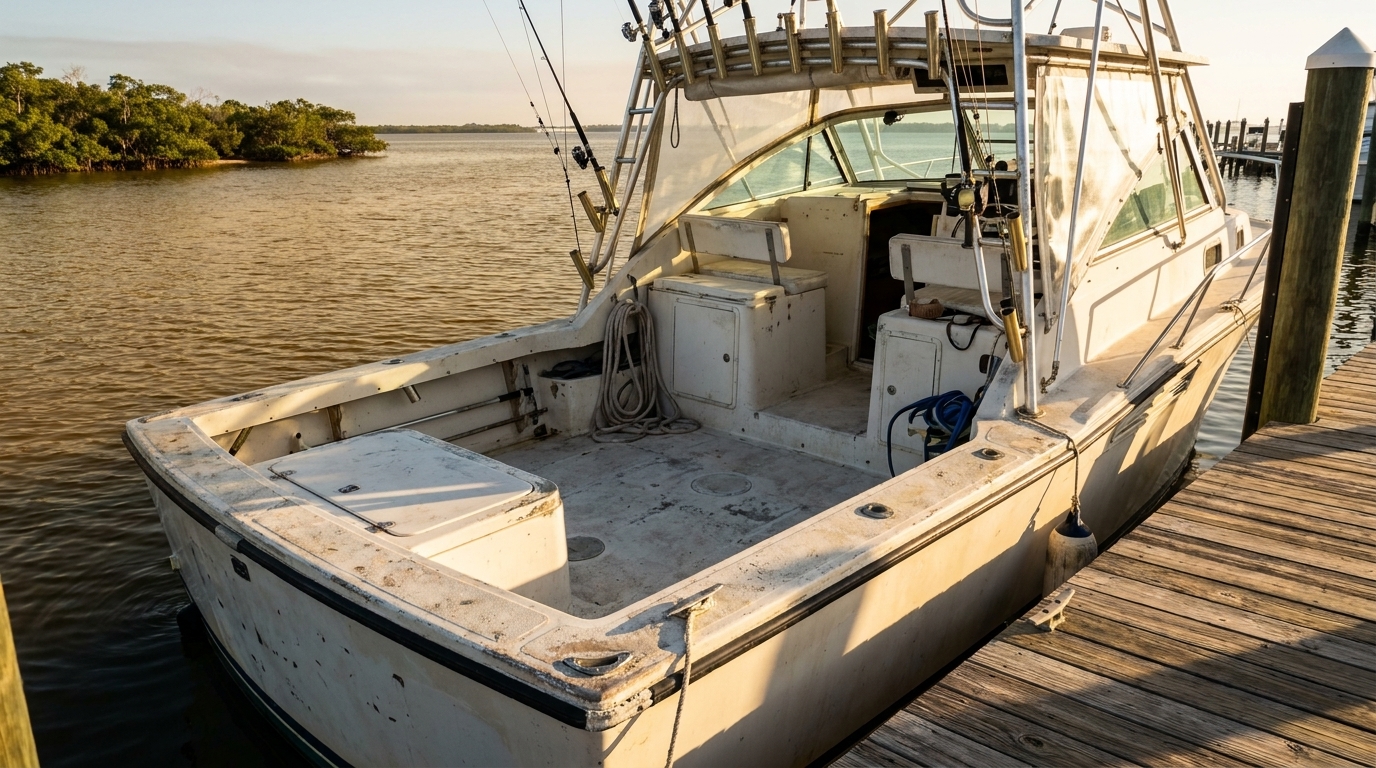
On sportfishing hulls specifically, examine the live-well plumbing and pump, the fish-box drains, and any tower or hardtop welds. Towers take stress every time a boat pounds through an inlet chop, and cracked welds at the base plates are common on boats that have run the St. Lucie Inlet regularly. Pull the engine cowling — a clean, sprayed-down powerhead with fresh anodes tells a very different story than one crusted with salt residue.
Hull and deck checks that matter on the Treasure Coast
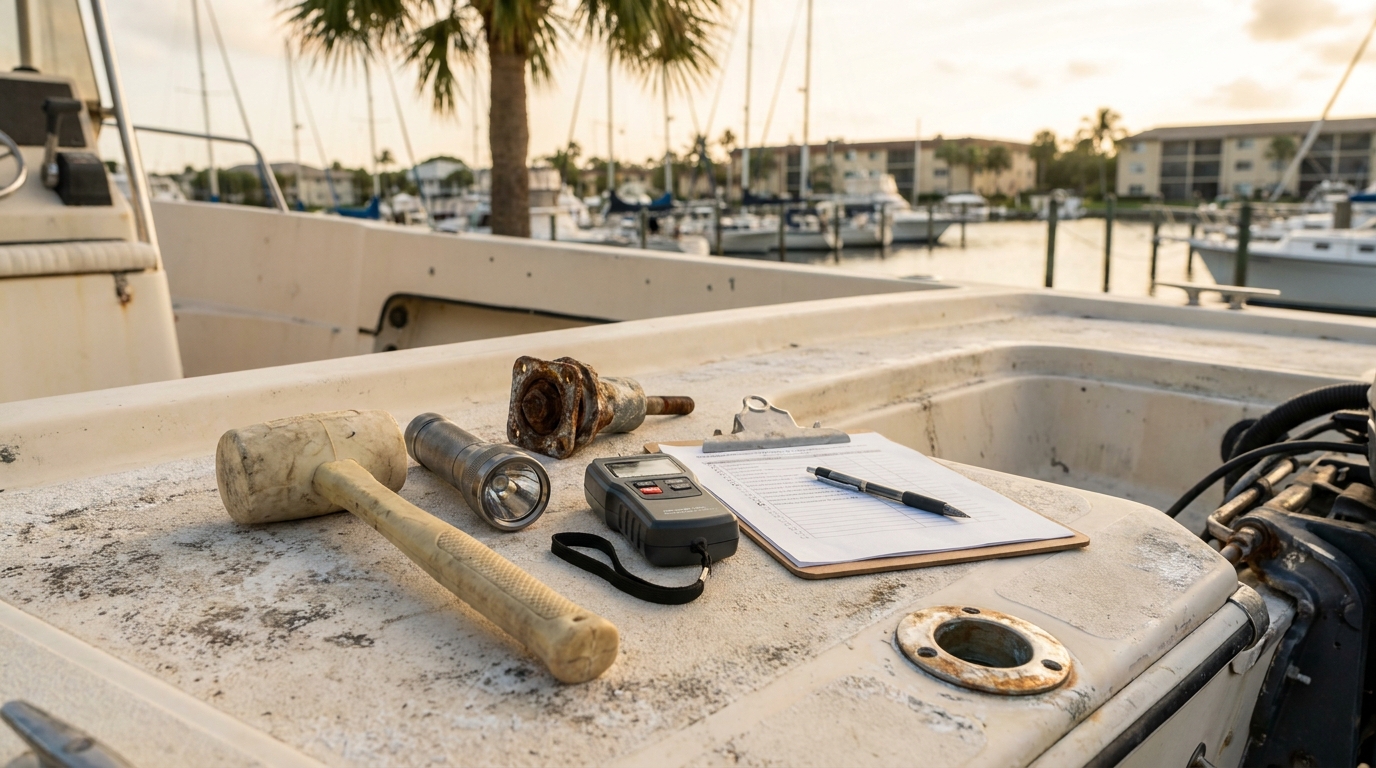
Tap the deck and transom with a plastic mallet; a dull thud instead of a sharp report signals a wet core. Look for stress cracks radiating from cleats, hardtop supports, and the transom-to-hull joint. On older center-consoles common in this market, transom softness around the outboard bolts is the single most expensive defect to miss.
How should a boat inspection checklist work in Stuart, FL?
A defensible Stuart inspection covers seven areas in order: hull and structure, propulsion, systems, safety equipment, trailer, sea trial, and — for larger or offshore-capable boats — a professional survey. Each area has go/no-go items that should be documented before any deposit is non-refundable. Skipping the sea trial or the survey to close faster is the most common expensive mistake local buyers make.
| Inspection area | What to verify | Common Stuart-area issue |
|---|---|---|
| Hull & structure | Soft decking, delamination, transom movement, blistering | Wet transom cores on older center-consoles |
| Propulsion | Compression or leak-down, lower unit, cooling, steering | Salt corrosion on powerhead and steering rams |
| Systems | Bilge pumps, electronics, chargers, live-wells, A/C | Failed live-well pumps, corroded electrical terminals |
| Safety gear | PFDs, extinguishers, distress signals, nav lights | Expired flares, missing offshore signaling |
| Trailer | Frame, brakes, bearings, tires, lights, VIN match | Rusted axles and seized brake calipers |
| Sea trial | Cold start, WOT, steering, alarms, fuel delivery | Overheating alarms only appearing under load |
| Survey | Independent report, valuation, insurance-grade findings | Undisclosed storm repair history |
What Florida titling and registration rules apply to a Stuart, FL purchase?
Florida generally requires titling and registration for motorized vessels operated, used, or stored on Florida waters, and the buyer has 30 days after purchase to complete the process through a county tax collector or authorized license-agent office. A non-motorized vessel under 16 feet is a notable exemption, and U.S. Coast Guard documented vessels typically aren't issued a Florida title but may still need Florida registration.
The paperwork must match the boat's hull identification number exactly. For a private-party purchase in Martin County, expect to present the previous owner's signed title and a bill of sale. A Class 1 vessel measuring 16 feet to under 26 feet carries a cited standard registration fee of $28.75, with title fees cited at $5.25 for electronic and $7.75 for paper — administrative costs only, separate from purchase price. Registration numbers must be displayed on both sides of the forward half of the hull in contrasting block characters at least three inches tall, per Florida Fish and Wildlife Conservation Commission rules.
Trailer paperwork is separate
Florida distinguishes trailers at a 2,000-pound empty or net-weight threshold: trailers at or above generally require titling and registration, while lighter trailers may require registration without a title. Verify the trailer's net weight, VIN, and title status independently — a boat deal that closes without clean trailer paperwork creates a headache the buyer inherits.
When does timing affect used boat prices in Stuart, FL?
Stuart's buying calendar has two meaningful windows. Winter and early spring bring snowbird demand, cruising traffic, and visiting anglers, which tightens inventory on desirable boats and shortens negotiating leverage. Late summer through fall carries hurricane and tropical-storm risk, which can soften pricing but also raises the importance of asking for insurance claims, repair invoices, and pre/post-storm photos.
Boats listed through hurricane season with no storm-preparation plan documented should trigger extra scrutiny. Undisclosed storm exposure — submerged electronics, water in the fuel, replaced-but-not-invoiced components — is one of the harder defects to spot after the fact. Buyers evaluating boats in September or October should ask specifically what the owner did during named storms and where the boat was hauled or stored.
What kind of boat fits Stuart, FL waters?
Stuart sits at the junction of the St. Lucie River, the Indian River Lagoon, the Atlantic through the St. Lucie Inlet, and the Intracoastal Waterway — which means the right boat depends heavily on where the buyer actually intends to run it. A flats skiff built for lagoon and backwater use is the wrong tool for offshore sailfish trips, and a fuel-hungry offshore center-console is over-boat for someone whose weekends are spent on the sandbar.
Match the hull to the water. Shallow-draft skiffs and bay boats suit the rivers and lagoon; center-consoles in the 23–28 foot range dominate the inlet-and-nearshore category; larger sportfish and cruisers make sense for Gulf Stream runs and Intracoastal travel. Overbuying wastes money on fuel, storage, and maintenance; underbuying is a safety problem when a summer thunderstorm builds off the inlet.
How should Stuart, FL buyers choose a broker or seller?
Look for a broker with documented Florida transaction experience, transparent handling of titling and escrow, willingness to coordinate an independent surveyor, and a track record of after-sale communication. Reputable brokerages such as Worldwide Yacht Sales, which carries a 4.8-star rating across 28 Google reviews as of May 2026, tend to be organized around exactly these points — closing paperwork, financing coordination, and post-sale logistics — rather than pushing inventory.
Customer feedback from the brokerage's reviews consistently emphasizes responsiveness on remote and long-distance transactions, careful documentation at closing, and multi-year buyer-seller relationships. Those are reasonable proxies for the kind of process a Stuart buyer wants: clean HIN-to-title matching, coordinated shipping when the boat is out of area, and a broker who returns calls after the check clears.
Frequently asked questions
How long do I have to register a used boat after buying it in Florida?
Florida gives buyers 30 days after purchase to complete titling and registration for a vessel that will be operated, used, or stored on Florida waters. The process runs through a county tax collector or authorized license-agent office, not the state headquarters directly. Missing the 30-day window can create administrative penalties and complicates insurance binding, so most Stuart buyers handle it within the first two weeks.
Do I need a marine survey for a used boat in Stuart, FL?
A professional marine survey is strongly recommended for larger boats, any vessel with inboard engines, boats intended for offshore use, and any purchase being financed or insured through a lender or insurer. Many Florida marine insurers effectively require a recent survey before binding coverage on older or larger vessels. For a small trailerable skiff bought from a known owner with full records, buyers sometimes skip it — but it remains the single best risk-reduction tool available.
What are the biggest red flags on a used Stuart center-console?
The biggest red flags are a soft or spongy transom, salt-encrusted powerhead with no service records, cracked welds at hardtop or tower bases, mismatched hull identification numbers between the boat and title, and any evidence of prior submersion. Undocumented storm repairs, replaced electronics with no invoices, and heavy corrosion on steering rams and trim tabs all warrant either a significant price adjustment or walking away entirely.
What fees should I expect beyond the purchase price?
Beyond the negotiated price, budget for Florida title and registration fees — cited at $28.75 standard registration for a Class 1 vessel 16 to under 26 feet, plus $5.25 electronic or $7.75 paper title fees — a professional survey where applicable, sales or use tax per Florida Department of Revenue rules, insurance, haul-out or storage arrangements, and any immediate maintenance the survey uncovers. Financing, transport, and dockage add further to total acquisition cost.
Is it safe to buy a used boat that's been through a hurricane?
Storm-exposed boats can be sound purchases when the damage was properly documented and professionally repaired, and dangerous when it wasn't. Ask for insurance claim records, repair invoices, and before-and-after photos. Have a surveyor specifically evaluate the electrical system, engine internals, fuel system, and structural repairs. Boats sold cheaply with vague answers about storm history are the ones that turn into expensive rebuilds.
Where should I sea-trial a boat I'm considering in Stuart?
An offshore-capable boat should be sea-trialed through the St. Lucie Inlet into open Atlantic water if conditions allow, so the buyer sees how it handles chop, runs at wide-open throttle, and behaves under sustained load. Inshore boats can be trialed in the St. Lucie River or Indian River Lagoon. Watch for overheating alarms, steering slop, vibration at cruise, and any smoke on cold start or hard acceleration.
Closing guidance
The Stuart used-boat market rewards patience and punishes rushed inspections. The buyers who end up happy are the ones who match the hull to the water, verify every document against the hull identification number, take the boat outside the inlet before signing, and treat any storm history or missing service records as questions to answer rather than details to overlook. Readers in Stuart, FL who want a Florida brokerage to help work through inspection, titling, and closing can reach Worldwide Yacht Sales at https://worldwideyachtsalesinc.com to discuss a specific boat or search.