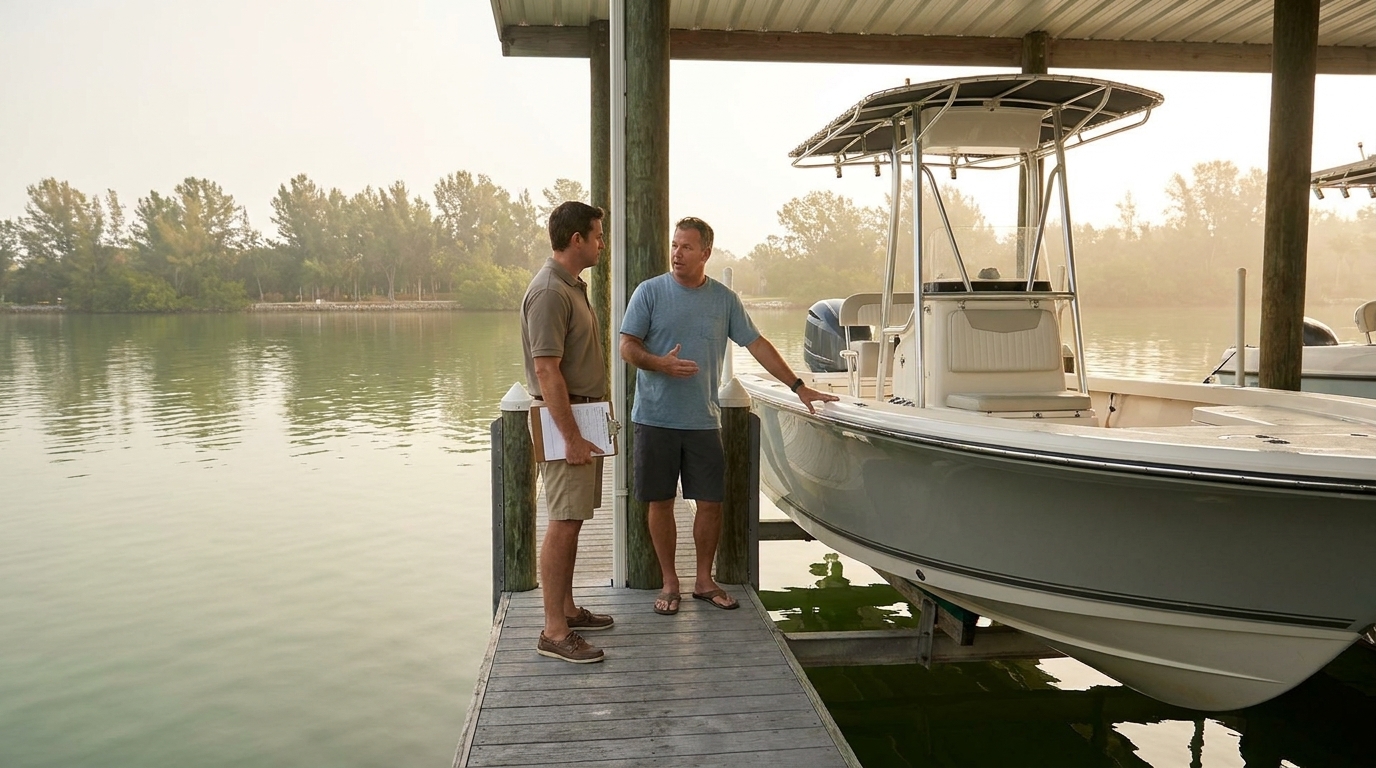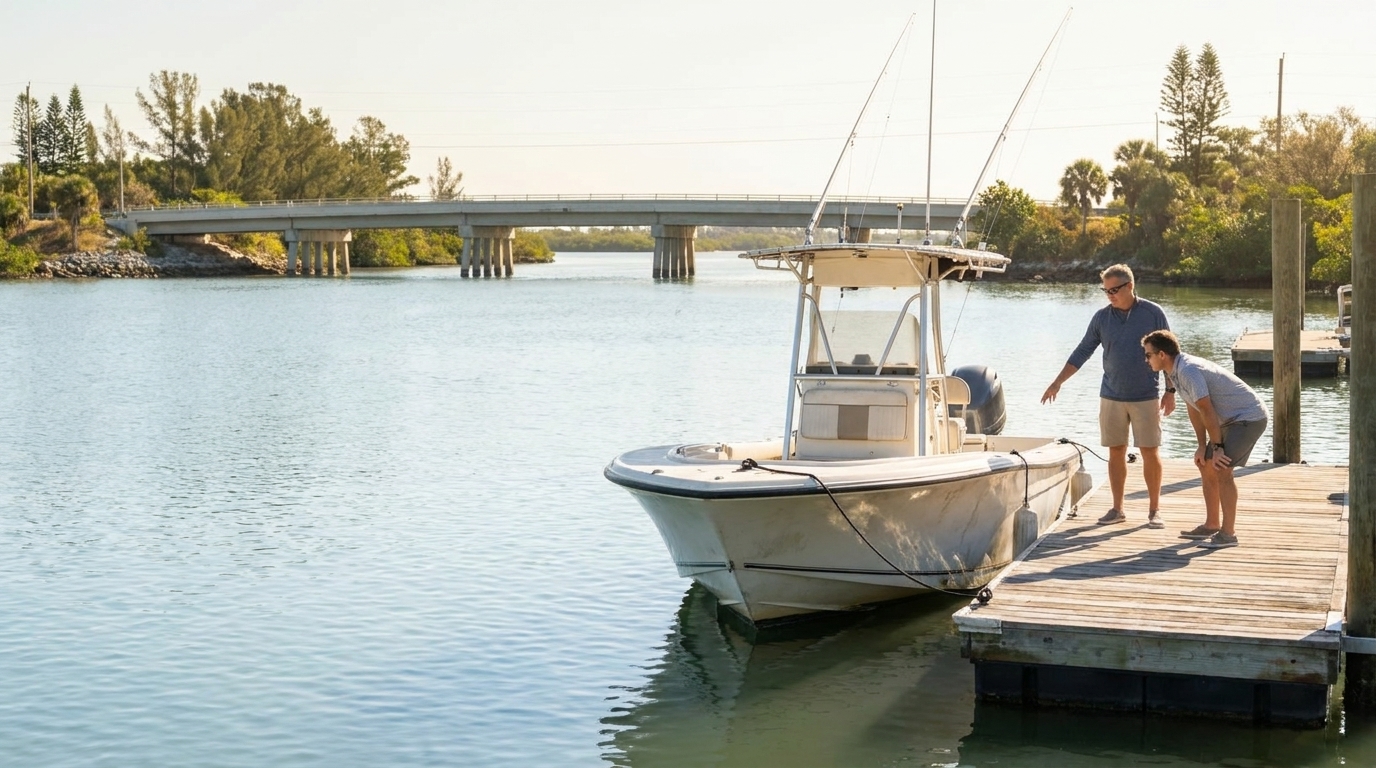
Boat Trade-In Toward a Larger Boat in Tampa, FL (2026)
How Tampa dealers value boat trade-ins, how equity applies toward a larger vessel, and what Florida's sales tax rule means for the upgrade math.

Tampa dealers typically offer trade allowances in the range of 55–65% of a boat's realistic retail value, with the final figure driven by engine hours, hull and mechanical condition, maintenance records, and how quickly comparable boats are moving locally. That allowance, minus any loan payoff, becomes equity applied directly against the larger boat's purchase price — and under Florida statute, the trade-in value is deducted from the taxable amount of the replacement vessel, lowering sales tax owed at closing.
What do Tampa dealers actually offer on a boat trade-in?
Tampa-area dealers generally offer between 55% and 65% of realistic retail value as a trade allowance, per a dealer-published guide, though this is not a fixed industry formula and real offers vary widely by model demand and condition. The offer reflects what the dealer believes it can wholesale the boat for if it does not retail, with margin built in for reconditioning and carrying costs.
That 55–65% band is an illustration, not a rule. A clean, in-demand center console with documented service may land at the top of the range or above; an older model with high engine hours and thin records may land well below. Engine hours function like mileage on a car — lower hours are more desirable in the resale market — and that single data point can swing an offer thousands of dollars in either direction.
Condition grading matters similarly. Dealers use a condition scale from rough to excellent, and each grade corresponds to a meaningful dollar difference in the offer. Worldwide Yacht Sales, a family-owned brokerage that has been serving yacht buyers and sellers for nearly four decades, evaluates trades in that same framework when a client is moving up to a larger vessel.
How does trade equity apply toward a larger boat in 2026?
Trade equity is the agreed allowance minus any remaining loan payoff on the current boat; whatever is left applies directly to the larger vessel's purchase price, with taxes, registration, and fees itemized separately. If the payoff exceeds the allowance, the difference rolls into the new financing rather than reducing it.
The mechanics matter when families upsize. A $90,000 allowance against a $30,000 payoff leaves $60,000 of equity to apply to, say, a 42-foot cruiser. The dealer coordinates payoff to the existing lienholder and obtains a clear title before completing the ownership transfer — a step that is non-negotiable when a lien exists.
| Line item | How it works in an upgrade |
|---|---|
| Trade allowance | Dealer-assigned value, often illustrated at 55–65% of realistic retail |
| Loan payoff | Deducted from allowance; dealer pays lienholder directly |
| Net trade equity | Applied against larger boat's purchase price |
| Florida sales tax | Calculated on purchase price minus qualifying trade value |
| Replacement discount | National industry surveys cite 5–15% off asking price as a typical range |
How does Florida's trade-in tax rule change the math?
Florida Statutes § 212.05 provides a deduction for the value of a qualifying used vessel accepted by a dealer and intended for resale, reducing the taxable base on the replacement boat when the trade happens in the same transaction. On a six-figure upgrade, that deduction often outweighs the gap between a dealer allowance and what a private sale might net.
Hillsborough County surtax rates apply on top of the state rate, and exact calculations should be verified with the Florida Department of Revenue or the Hillsborough County Tax Collector. Federally documented vessels, out-of-state titles, and existing liens each have their own paperwork path, and the Florida Department of Highway Safety and Motor Vehicles is the authority on titling and the commonly cited 30-day transfer deadline.
What drives a stronger trade offer on a Tampa boat?
Four factors move a Tampa trade offer more than anything else: engine hours, documented maintenance, hull and mechanical condition, and local resale demand for the specific model. Boats with lower engine hours are generally more desirable in the resale market, and a well-maintained vessel with consistent service records typically fetches a higher trade value than an identical boat without them.
Local demand is the wild card. National powerboat registrations for vessels 15 feet and over are running below their rolling average, and Florida is also below its average — meaning Tampa dealers are more selective about which models they can confidently retail versus wholesale. A model that moves quickly off a Westshore or Gandy-area lot will draw a stronger offer than one the dealer expects to sit through hurricane season.
Timing matters too. Dealerships often see stronger demand for used boats before the boating season begins, which can improve trade-in opportunities. In Tampa, that means owners weighing an upgrade have a practical reason to complete the transaction before the Atlantic hurricane season, which runs June 1 through November 30 and influences insurance terms, haul-out planning, and storm-prep costs.
"I couldn’t be happier with the entire staff. They used all their resources to help me get into the Yellowfin I’ve always dreamt of!!!" — 5★ · Brad, Mar 2026
Should Tampa families upsizing consider a private sale instead?
Private sales often produce a higher gross price than a dealer trade allowance, but the net difference — after showings, negotiation, title transfer, loan payoff coordination, and the lost Florida sales tax deduction — is frequently smaller than owners expect. Trading at a dealership offers a faster transaction with no need to advertise the boat.
For a family moving from a 24-foot bay boat to a 40-foot cruiser, the trade route also compresses a complex two-sided transaction into a single closing. That matters when the replacement vessel is already identified and the owner does not want to carry two boats, two insurance policies, and two slip fees through a Tampa summer.
What should buyers verify before closing an upgrade?
Before closing, buyers should confirm the dealer holds a current Florida vessel dealer registration, verify that the bill of sale, title, lien release, and tax documents are completed correctly, and — for any pre-owned replacement — commission an independent survey. Worldwide Yacht Sales's yacht buying team notes an important distinction many first-time upgraders miss.
From Worldwide Yacht Sales's yacht buying team: Buyers think a clean-looking boat is a sound boat, and that a survey is a pass-or-fail stamp. A survey is a snapshot of what the surveyor could see and test that day; it doesn't open up every hidden space, and a hull survey doesn't fully cover the engines. That's why we usually recommend a separate engine survey with oil analysis on top of the hull survey.
That advice carries particular weight when stepping up to a twin-engine cruiser or larger diesel platform, where engine replacement costs can rival the boat's net value. Industry valuation tools, including sources like J.D. Power's boat values and other published guides, anchor retail expectations but do not substitute for a hands-on inspection.
Frequently asked questions
What percentage of retail value do Tampa boat dealers typically offer on a trade?
A dealer-published guide illustrates trade allowances at roughly 55% to 65% of realistic retail value, though this is not a fixed industry standard and actual offers vary widely by model demand, engine hours, condition, and local resale prospects. Tampa-specific sold-price medians are not established by available sources, so each offer should be evaluated against the specific boat and current conditions.
Does Florida reduce sales tax when I trade in a boat?
Yes. Florida Statutes § 212.05 provides a deduction for the value of a qualifying used vessel accepted by a dealer and intended for resale, reducing the taxable base on the replacement boat. The deduction applies when the trade and purchase occur in the same transaction; county surtax calculations should be verified with the Florida Department of Revenue or the Hillsborough County Tax Collector.
How is trade equity calculated when upgrading to a larger boat?
Trade equity equals the dealer's agreed trade allowance minus any remaining loan payoff on the current boat. The remaining equity applies directly toward the replacement vessel's purchase price. If the payoff exceeds the allowance, the shortfall typically rolls into the new financing. The dealer coordinates lienholder payoff and obtains clear title before completing the transfer.
What boat condition factors most influence a Tampa trade offer?
Engine hours, hull and mechanical condition, documented maintenance records, and local resale demand for the specific model are the primary drivers. Lower engine hours are generally more desirable, and dealers use a condition grading scale from rough to excellent where each step corresponds to a meaningful difference in the offer. Market saturation of similar models can also pull offers down.
Is it better to sell privately or trade in when moving up to a larger vessel?
Private sales often produce a higher gross price, but a dealer trade is faster, eliminates advertising and showing work, and preserves the Florida sales tax deduction on the replacement boat. For families already identified on a larger vessel, trading consolidates the transaction into one closing and avoids carrying two boats through the Tampa boating season.
When is the best time of year to trade in a boat in Tampa?
Dealerships often see stronger demand for used boats before the boating season begins, which can improve trade-in opportunities. In Tampa, many owners also prefer to close an upgrade ahead of the Atlantic hurricane season — June 1 through November 30 — which affects insurance terms, haul-out planning, and storage costs for whichever vessel they end up owning.
What paperwork is required to transfer a Florida boat title in a trade?
Florida requires vessel title transfer and registration through the county tax collector or an authorized agent, with a 30-day transfer window commonly cited. Federally documented vessels, out-of-state titles, and boats with existing liens have additional requirements. The Florida Department of Highway Safety and Motor Vehicles is the authority to confirm the specific documents for any individual transaction.
Closing the upgrade with confidence
Trading up is less about chasing the highest headline number and more about understanding how the allowance, payoff, Florida tax deduction, and replacement-boat pricing work together. Owners who document maintenance, verify county-specific tax figures, and commission proper surveys on the larger boat consistently end up with better outcomes than those who focus on a single line item.
Readers in Tampa, FL who want this handled professionally — from valuation through closing on a larger vessel — can reach Worldwide Yacht Sales at (727) 346-8229 or https://worldwideyachtsalesinc.com to get started.