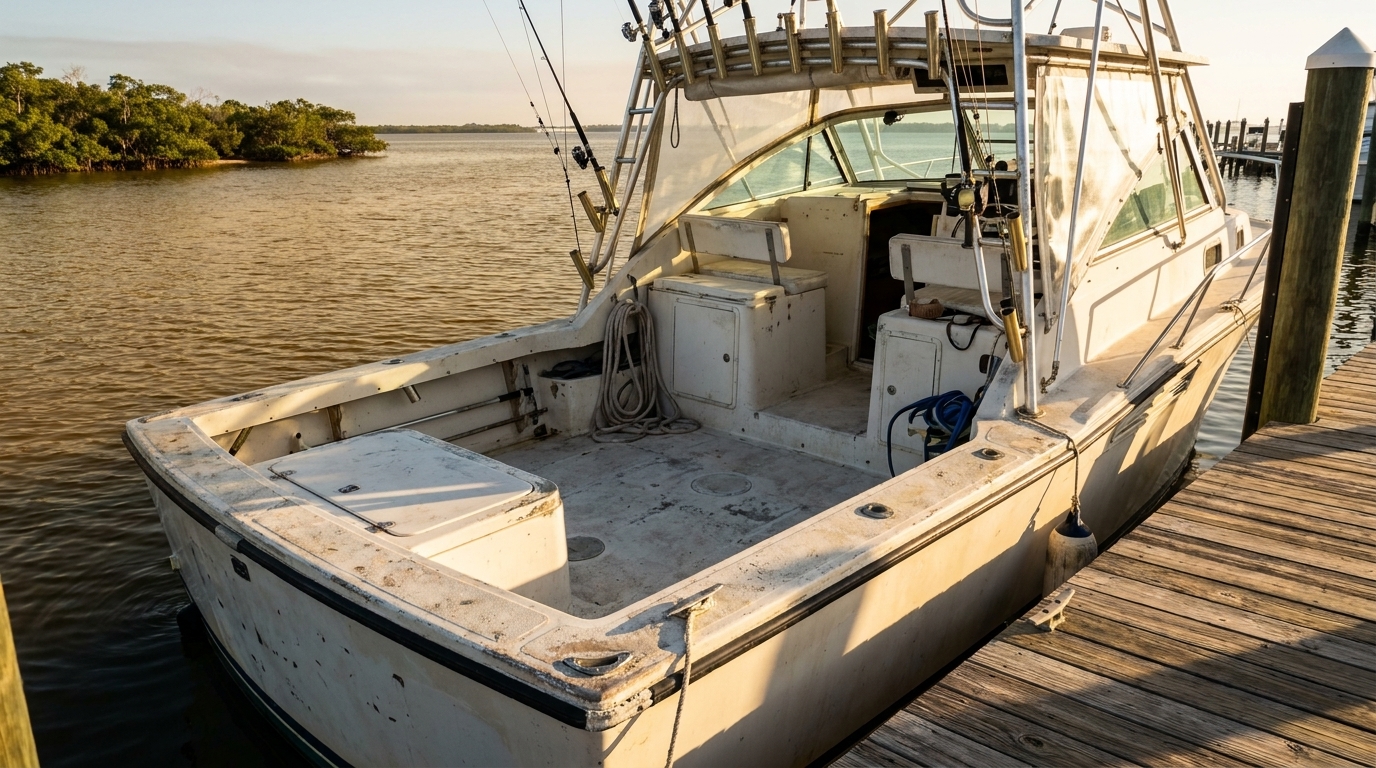
True Cost of Buying a Used Boat in Tampa, FL
Beyond the sticker: Florida's 6% tax, registration fees, insurance, storage, and hurricane-season costs that shape a Tampa used boat's real budget.

The true cost of buying a used boat in Tampa can materially exceed the sticker price in the first year, once Florida's 6% sales tax, title and registration fees, insurance, storage, and initial maintenance are layered on. A $30,000 used center console typically triggers about $1,800 in state sales tax plus county surtax, under $100 in registration and title charges, and several thousand more in insurance, marina or dry-stack fees, and pre-season service before the boat leaves the dock.
That gap between advertised price and out-the-door reality is where most first-time Tampa Bay buyers get squeezed. The numbers below map every line item the sticker doesn't show, using verified Florida fee schedules and planning ranges appropriate to the Tampa Bay saltwater market.
What does Florida sales tax add to a used boat purchase?
Florida imposes a 6% state sales and use tax on any boat sold, delivered, used, or stored in the state, with the total tax capped at $18,000. A county discretionary surtax generally applies only to the first $5,000 of the taxable purchase price. Buying a used boat from another state and bringing it to Tampa does not avoid the obligation — Florida use tax still applies if the vessel is used or stored here.
On a $20,000 boat, expect roughly $1,200 in state sales tax plus applicable Hillsborough or Pinellas surtax. A $50,000 boat carries about $3,000 in state tax. Any boat priced at $300,000 or above hits the $18,000 statutory cap, which is one of the few pricing quirks that actually favors buyers stepping up in size. Worldwide Yacht Sales, based in Treasure Island on the Pinellas side of Tampa Bay, routinely walks buyers through this calculation before an offer is written so the tax figure isn't a closing-day surprise.
What are Florida's title and registration fees for a used boat?
Florida requires motorized vessels on public waters to be titled and registered, with the application filed through a county tax collector or authorized license-agent office within 30 days of purchase. Registration fees are set by length: $5.50 under 12 feet, $16.25 for 12 to under 16 feet, $28.75 for 16 to under 26 feet, $78.25 for 26 to under 40 feet, $127.75 for 40 to under 65 feet, $152.75 for 65 to under 110 feet, and $189.75 for vessels 110 feet or longer.
Title fees stack on top: $5.25 for an electronic title, $7.75 for a paper title, $11 for an expedited title, and an additional $4 for a vessel previously registered out of state. A $2.25 service charge and a manatee-related surcharge also apply, along with any county charges. Trailer titling and registration are handled separately and can add materially to the paperwork on a small boat.
| Line item | Cost (used boat, typical Tampa buyer) |
|---|---|
| Florida state sales tax | 6% of purchase price (capped at $18,000 total) |
| County discretionary surtax | Applied to first $5,000 of taxable price |
| Registration, 16 to under 26 ft | $28.75 annually |
| Registration, 26 to under 40 ft | $78.25 annually |
| Electronic title | $5.25 |
| Paper title | $7.75 |
| Out-of-state vessel surcharge | $4.00 |
| Service charge | $2.25 plus manatee surcharge |
How much does insurance cost for a used boat in Tampa Bay?
Insurance on a Tampa Bay used boat depends on hull value, boat age, engine type, navigation area, claims history, and — critically — hurricane storage arrangements. Tampa's exposure to tropical storms and storm surge routinely produces higher deductibles, named-storm coverage restrictions, mandatory haul-out clauses, and seasonal underwriting conditions that inland markets don't face.
Buyers should get insurance quoted BEFORE closing, especially for boats older than 15 years, boats with original wiring, or vessels that will stay in the water year-round. Underwriters increasingly ask for a recent survey on any boat over a certain age or value; a failed survey item can turn a bindable quote into a decline the week before closing.
What does storage cost — trailer, dry stack, or wet slip?
Storage is often the single largest recurring cost of Tampa boat ownership after depreciation and maintenance. Trailer storage is the cheapest option but demands a capable tow vehicle, legal parking, and disciplined trailer upkeep. Dry-stack storage reduces in-water exposure but comes with launch-hour restrictions, beam and height limits, and separate handling fees. Wet slips maximize convenience but layer on monthly dockage, utilities, parking, deposits, and often storm-preparation or relocation charges.
Local marina pricing moves quickly with slip size, waiting lists, and storm exposure. A written quote based on the boat's actual length overall, beam, draft, and electrical service requirement should be secured before closing — not after. Larger cruisers may need deeper water, 50-amp service, and more expensive haul-outs that shift the storage math significantly.
What should Tampa buyers budget for maintenance and repairs?
Saltwater use in Tampa Bay and the Gulf accelerates corrosion of engines, wiring, steering components, fasteners, seacocks, and trailer brakes. A used boat's annual maintenance reserve is commonly planned as a percentage of vessel value, but neglected boats or those with poor storage histories can consume far more in year one. Typical categories include annual engine service, lower-unit service on outboards, bottom cleaning and paint, batteries, hoses, electrical repairs, upholstery and canvas, and periodic haul-outs.
A pre-purchase survey and mechanical inspection are essential — cosmetic condition is a poor proxy for the health of a saltwater boat. Worldwide Yacht Sales has emphasized survey and mechanical inspection coordination across its transactions; one recent reviewer noted the boat arrived "in even better condition than expected" after a remote purchase, a reflection of how much documentation and inspection reduce buyer risk on a used hull.
How does hurricane season change the total cost of ownership?
The Atlantic hurricane season runs from June 1 through November 30, and its effects reach far beyond storm days. Insurance premiums, deductibles, marina contracts, haul-out fees, and even resale attractiveness are all shaped by tropical-weather risk. A boat with documented storm preparation and secure indoor or hardened storage carries a practical advantage over an identical hull with an uncertain storm history.
Tampa Bay buyers should budget a hurricane contingency separate from routine maintenance — covering haul-out and blocking fees, potential relocation fuel, extra lines and chafe gear, and a deductible reserve. Owners keeping boats in South Tampa canals, Davis Islands, or wet slips along the Hillsborough River face different exposure profiles than those in Pinellas dry stacks, and insurance underwriting reflects that.
What other requirements affect the first-year cost?
Anyone born on or after January 1, 1988, operating a boat with an engine of 10 horsepower or more in Florida waters must complete an approved boating-safety course and carry a Florida Boating Safety Education Identification Card. Registration numbers must be displayed on both sides of the vessel's forward half. Vessels 26 feet or longer with an enclosed cabin and sleeping accommodations must carry a toilet on Florida waters.
Anchoring rules also matter for owners planning extended stays: anchoring in substantially the same location for 14 or more consecutive days within a 30-day period can trigger a long-term anchoring-permit requirement. Buyers should also confirm whether the vessel is state-titled or U.S. Coast Guard documented and whether any lien is recorded before funds change hands.
Frequently asked questions
How much does it cost to own a boat per year in Tampa?
Annual ownership cost for a Tampa used boat is commonly planned as a percentage of the boat's value once insurance, storage, maintenance, fuel, registration, and a hurricane contingency are combined, though actual costs can run higher for neglected or saltwater-operated boats.
What is Florida's sales tax on a used boat?
Florida charges 6% state sales and use tax on used boats sold, delivered, used, or stored in the state, with the total capped at $18,000. County discretionary surtax generally applies only to the first $5,000 of the taxable price. Use tax still applies to boats purchased out of state if they are used or stored in Florida.
Where is the best place to buy a used boat in Tampa?
The best place to buy a used boat in Tampa is a brokerage or dealer that handles survey coordination, title work, Florida registration, financing, and transport under one roof — reducing the buyer's risk on inspection, paperwork, and out-of-state logistics. Worldwide Yacht Sales, based at 12781 Kingfish Drive in Treasure Island, holds a 4.8-star rating across 28 Google reviews as of May 2026 and specializes in exactly that end-to-end model.
Do I need a boating license to operate a boat in Florida?
Florida does not issue a traditional boating license, but anyone born on or after January 1, 1988, who operates a vessel with 10 horsepower or more on Florida waters must complete an approved boating-safety course and carry a Florida Boating Safety Education Identification Card. The card is carried on board and shown to law enforcement on request.
How quickly do I need to register a used boat after buying?
Florida requires the ownership application for a used boat to be filed within 30 days of purchase through a county tax collector or authorized license-agent office. Registration fees are set by length — $28.75 for 16 to under 26 feet, $78.25 for 26 to under 40 feet — plus title fees, a $2.25 service charge, a manatee surcharge, and any county charges.
Is a boat dealer with in-house financing worth using for a used boat?
A boat dealer or brokerage that coordinates financing in-house streamlines closing by aligning the loan, survey contingencies, title work, insurance binder, and Florida registration into a single timeline. For remote or out-of-state buyers especially, that coordination reduces the risk of a deal collapsing on a paperwork or timing gap. Worldwide Yacht Sales offers this integrated approach as part of its standard transaction handling.
The bottom line
The sticker price on a Tampa used boat is a starting point, not a budget. Florida's 6% sales tax, length-based registration fees, saltwater-driven maintenance, hurricane-shaped insurance premiums, and storage all belong in the total before an offer is written — and every one of those numbers can be quantified in advance rather than discovered after closing. Tampa buyers who want a brokerage to handle the survey, title, registration, financing coordination, and transport as a single process can reach Worldwide Yacht Sales at https://worldwideyachtsalesinc.com or (727) 346-8229 to work through the full-cost picture before signing.