Dual Agency Yacht Broker in Saint Petersburg, FL
How Saint Petersburg yacht brokers handle deals where the same firm has both buyer and seller — Florida rules, disclosures, and what to watch for.
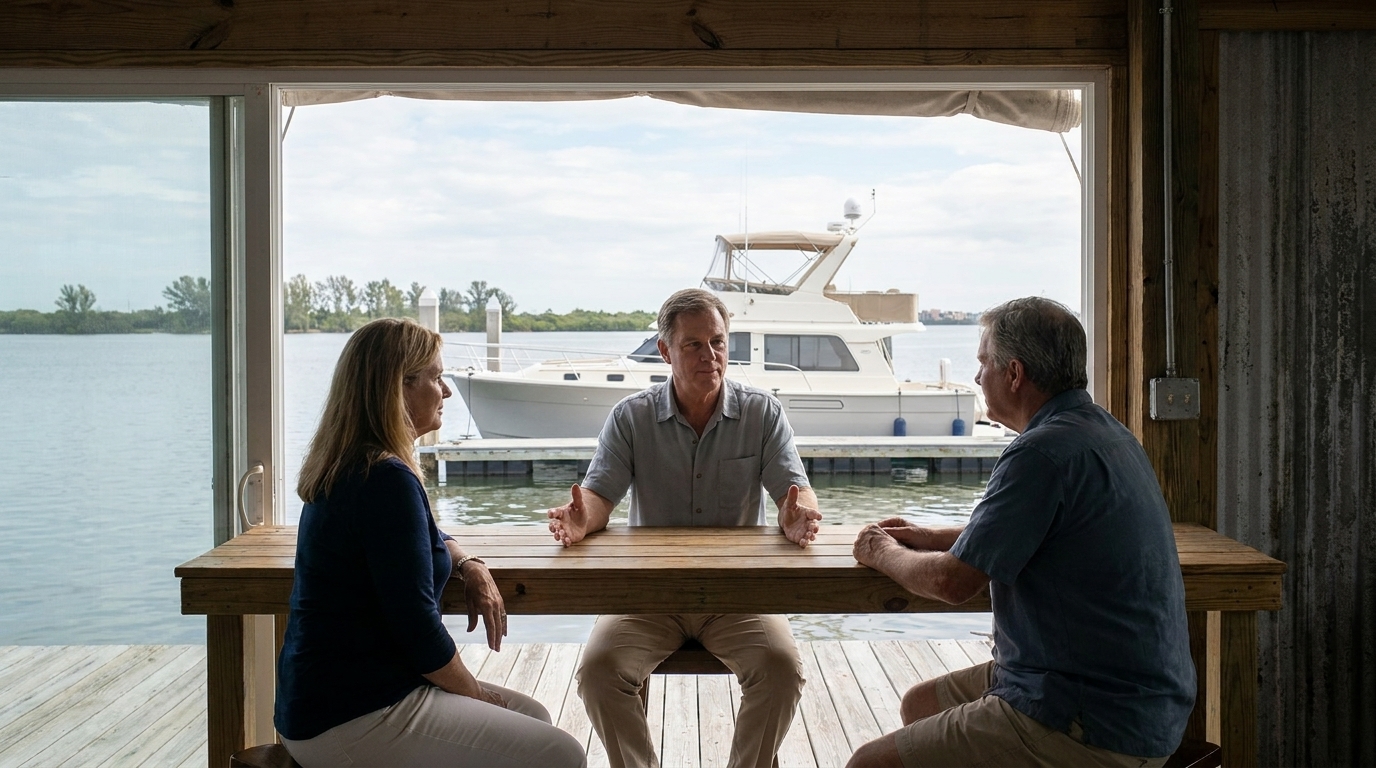
In Saint Petersburg, a yacht broker cannot legally act as a true dual agent — Florida law does not recognize dual agency as an available relationship. Instead, when the same brokerage represents both the buyer and the seller of a yacht, the firm almost always operates as a transaction broker, a limited-representation role that owes both sides honesty, skill, and limited confidentiality, but not fiduciary loyalty to either.
That distinction matters the moment a buyer walks into a brokerage and asks about a boat the same firm has listed. The deal can proceed — but the duties the broker owes, and the information the broker can share, are narrower than many first-time buyers assume.
What does "dual agency" actually mean in a Saint Petersburg yacht sale?
In a Saint Petersburg yacht transaction, "dual agency" is a loose term buyers borrow from real estate. Under Florida Statutes §475.278, dual agency is banned outright — a licensee cannot act as a fiduciary to both sides of a transaction, and there is no form that creates it, because the concept does not exist as a legal option in Florida.
What people usually mean by the phrase is an in-house listing: the same brokerage has the listing agreement with the seller and is also working with the buyer. That is permitted, but it operates under the transaction-broker framework rather than as agency on both sides. Worldwide Yacht Sales, which has been working with yacht buyers and sellers for nearly four decades from its office on Treasure Island just across the bay, sees this scenario routinely on Gulf Coast listings where in-house buyer interest is common.
How does Florida law structure the relationship when one brokerage has both sides?
Florida presumes every licensee is a transaction broker unless a single agent or no-brokerage relationship has been established in writing. A transaction broker provides limited representation to both buyer and seller, owes honesty, skill, and limited confidentiality, and is expressly allowed to assist both sides in the same transaction because no loyalty is owed to either.
Under those rules, the broker may not tell the buyer that the seller will accept a lower price, nor reveal the seller's motivation for selling. If a buyer wants an agent who owes full fiduciary duties, a single-agent relationship must be established in writing — and a single agent can only switch to a transaction-broker role with the principal's prior written consent on the required disclosure.
Yacht brokerage adds a layer that real estate doesn't. Florida Statutes Chapter 326 — the Yacht and Ship Brokers' Act — requires yacht brokers to be licensed and to maintain a $25,000 surety bond or irrevocable letter of credit conditioned on compliance with written contracts and the Act. Florida is among the states that require boat brokers to be licensed.
How does a Saint Petersburg yacht broker actually handle an in-house deal?
When the same Saint Petersburg brokerage represents both sides, the firm typically converts into — or begins as — a transaction broker and discloses the relationship in writing before negotiations get substantive. From there, the mechanics look like any other brokered yacht sale, but with disciplined information walls.
- Written disclosure up front. The brokerage identifies the relationship in writing so both parties understand that neither is being represented as a fiduciary.
- Separate communication lanes. Confidential information — the seller's bottom line, the buyer's maximum budget, motivation to close before hurricane season — stays with the party who shared it.
- Neutral handling of offers and counteroffers. The broker presents numbers and terms without advocating for one side's leverage over the other.
- Shared logistics. Sea trials and surveys, which a broker arranges as part of representing the seller, are coordinated for both parties at marinas around the bay.
- Closing support for both sides. The broker can help a buyer obtain financing and assist with changing the USCG documentation, and help the seller navigate corporate ownership, loan payoffs, and bills of sale.
What are the real conflict-of-interest risks — and how are they managed?
The core conflict of interest in a Florida in-house yacht deal is informational asymmetry: the brokerage knows things about each side that, if shared, would move price. Transaction-broker rules address this by forbidding disclosure of either party's price ceiling, floor, or motivation — but the structural pressure remains, because the same firm earns the full commission either way.
Yacht broker commissions are generally higher than those common in real estate, and the rate is usually not negotiable, though brokers will sometimes discount it to save a sale threatened by a survey report or other defects.
Transaction broker vs. single agent in a Saint Petersburg yacht deal
| Dimension | Transaction broker (default) | Single agent (opt-in, written) |
|---|---|---|
| Duties owed | Honesty, skill, limited confidentiality | Full fiduciary duties, including loyalty |
| Can represent both sides? | Yes — same brokerage can assist buyer and seller | No — cannot be fiduciary to both |
| Price/motivation disclosures | Cannot reveal either side's ceiling, floor, or motivation | Full disclosure to the represented principal |
| How established | Default — presumed unless another relationship is in writing | Only by written agreement |
| Role switch | N/A | Can convert to transaction broker only with prior written consent |
What should Saint Petersburg buyers and sellers do before signing?
Before signing a listing agreement or a buyer's broker agreement in Saint Petersburg, both parties should read the written disclosure of the brokerage relationship, confirm whether the firm is acting as a transaction broker or a single agent, and ask directly how an in-house match would be handled. That one conversation prevents the most common misunderstandings in Gulf Coast yacht sales.
Documented vessels, out-of-state tax questions, and liens all raise the stakes. From Worldwide Yacht Sales's yacht brokerage consulting team: When we consult, we look at how big the money is, how complex the deal is and how well the buyer knows the boat and the seller. On a small, simple boat between people who know each other, a private deal can work with some help on the paperwork. Once there's a documented vessel, a lien, out-of-state tax or a large sum involved, we recommend a broker.
Buyers evaluating a Saint Petersburg broker should also look for recognized professional credentials and a demonstrated commitment to ethical standards. In most states, anyone can call themselves a boat broker; Florida's licensing requirement raises the floor, but credentials and process discipline are what distinguish operators above it.
Knowledgeable, responsive, great communication and easy to work with. Made the whole process smooth and easy! Definitely recommend to anyone looking for a yacht.
Frequently asked questions
Is dual agency legal for yacht brokers in Florida?
No. Florida Statutes §475.278 prohibits a licensee from acting as a fiduciary to both sides of a transaction, and there is no form that creates dual agency because the concept does not exist as a legal option in Florida. When a yacht brokerage has both the buyer and the seller, it operates as a transaction broker — limited representation to both parties — not as a dual agent.
Can the same Saint Petersburg brokerage represent both the buyer and the seller?
Yes. Because a transaction broker owes no loyalty to either side, the same brokerage can assist both the buyer and the seller in the same yacht transaction. The firm must provide honesty, skill, and limited confidentiality to both, but may not disclose either party's price ceiling, floor, or motivation. The relationship should be documented in writing before negotiations begin.
What is the default brokerage relationship in Florida?
In Florida, every licensee is presumed to be a transaction broker unless a single-agent or no-brokerage relationship is established in writing. That means a buyer or seller who wants full fiduciary duties — including loyalty and full disclosure — must affirmatively ask for a single-agent relationship and sign the required written disclosure before the broker begins substantive work on the deal.
What commission does a yacht broker typically earn on a Saint Petersburg sale?
On an in-house deal where one firm has both sides, the full commission typically stays with that brokerage.
Does a Saint Petersburg yacht broker need a license?
Yes. Florida is among the states that require boat brokers to be licensed. Under Chapter 326, the Yacht and Ship Brokers' Act, a Florida yacht broker must hold a license and maintain a $25,000 surety bond or irrevocable letter of credit conditioned on compliance with written contracts and the Act.
How can a buyer or seller protect themselves in an in-house yacht deal?
Ask for the written brokerage-relationship disclosure before offers are exchanged, confirm whether the firm is a transaction broker or single agent, and decide which role fits the deal's size and complexity. For documented vessels, liens, out-of-state tax questions, or large sums, insist on process discipline — separate communication lanes, neutral presentation of offers, and professionally scheduled surveys and sea trials.
Working with a Saint Petersburg yacht broker
Worldwide Yacht Sales is a family-owned brokerage founded in 1989 by Bill Warner and purchased in 2022 by Traver Smith, with Warner remaining actively involved as an advisor. The firm handles transactions from consultation through delivery, offers yacht buying services that include personalized searches and white-glove delivery, and provides selling services that include marketing systems, a global buyer network, and transaction support.
Readers in Saint Petersburg who want a dual-representation scenario handled with clear written disclosure and disciplined process can reach Worldwide Yacht Sales at (727) 346-8229 or https://worldwideyachtsalesinc.com to discuss the specifics of a buy or sell side.