Center Console vs Pontoon Boat for Tampa Bay, FL
A local-insider comparison of center consoles and pontoons for Tampa Bay — hull performance, fishing vs. family use, storage, and what fits local waters.
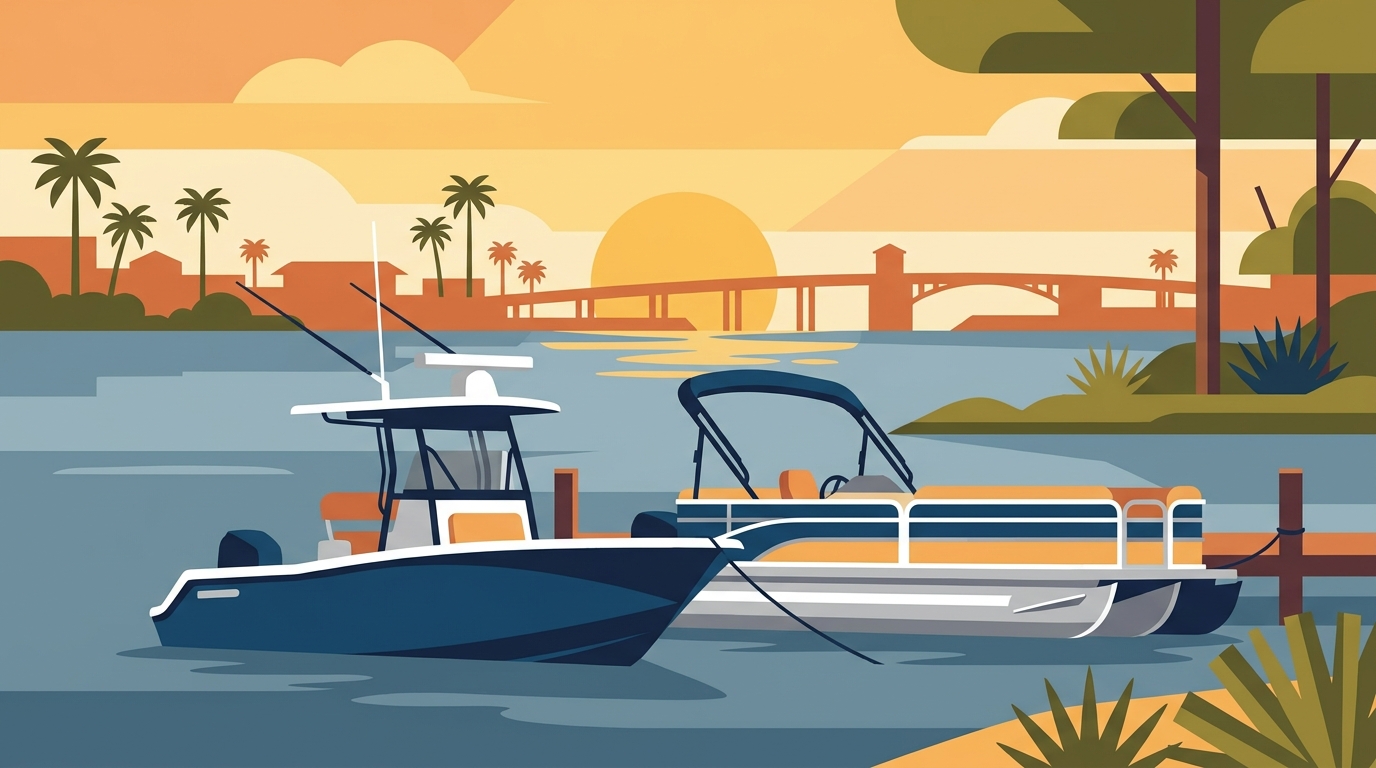
For most Tampa Bay boaters, a center console is the better all-around choice when fishing, chop crossings, or nearshore Gulf runs are on the agenda, while a pontoon wins for sheltered-water family days, sandbar afternoons, and easy boarding. The deciding factors are which side of the Skyway you run, how often you cross open water, and how many people typically come aboard.
Tampa Bay is not one body of water — it is an estuary of exposed reaches, shipping channels, mangrove backwaters, and shallow flats, all bordered by barrier islands and Gulf passes. That geography rewards a deliberate hull choice more than a stylistic preference. Worldwide Yacht Sales, based on Treasure Island at the mouth of Boca Ciega Bay, works this coastline daily and sees both categories move for very different reasons.
Which boat handles Tampa Bay chop better?
A center console handles Tampa Bay chop better in nearly every scenario that involves open water. Its deep-V or modified-V hull cuts through the short, steep wind waves the bay generates on breezy afternoons, while a pontoon's flat tubes pound and slow down in the same conditions. For runs across the bay's open reaches or through Gulf passes, the center console is the safer, drier choice.
Afternoon sea breezes off the Gulf routinely kick up a 2-to-3-foot chop across the middle of Tampa Bay, particularly from late spring through summer. A 21-to-24-foot center console with adequate freeboard tracks through that water at a workable cruising speed; a pontoon of similar length is generally happier staying inside protected water like the Manatee River, upper Old Tampa Bay, or the ICW behind the barrier islands.
Tritoons — pontoons with a third center tube — narrow the gap and can handle moderate open-bay conditions with more speed and stability than a traditional two-tube layout. They are still not a Gulf-pass boat, but they extend a pontoon's usable water meaningfully.
Which is the better fishing platform for Tampa Bay?
The center console is the clear fishing platform for Tampa Bay. Its 360-degree deck access, elevated helm visibility for spotting fish on the flats, gunwale rod holders, livewells, and forward casting deck are all purpose-built for inshore and nearshore fishing. Pontoons can fish, but they are recreational boats that accommodate fishing, not fishing boats.
For serious anglers targeting snook along the mangroves, redfish on the flats east of the Skyway, or grouper on nearshore Gulf structure, a bay boat or center console in the 18-to-24-foot range is the working answer. Shallower drafts open up the flats around Weedon Island and the Little Manatee River mouth; deeper hulls extend range through the passes.
Pontoons excel at a different kind of on-water use — anchoring off Beer Can Island, cruising the ICW at sunset, tubing kids on a calm morning. Trying to make a pontoon into a serious fishing boat generally produces a mediocre version of both.
Which fits Tampa Bay families better?
Pontoons fit larger, casual Tampa Bay family groups better, and center consoles fit smaller, more active or fishing-oriented families better. A pontoon offers wraparound seating, shaded lounging, a walk-on bow gate, and enough deck space for eight to twelve people to spread out — a genuine advantage for multi-generational days on the water.
The Tampa Bay family-boating pattern often involves sandbar destinations — the sandbar off Passage Key, the flats behind Egmont, or the shallows near Fort De Soto — where boarding, swimming, and hanging out matter more than speed. A pontoon or tritoon is built for exactly that use, with easy in-water access and low freeboard for climbing back aboard.
For families that also want to fish, run to lunch across the bay, or occasionally head through Pass-a-Grille or Egmont Channel into the Gulf, a dual console or a family-configured center console with a bow seating cushion delivers more versatility. When buyers ask about the best boat for Tampa Bay families, the honest answer is that it depends on whether the family fishes.
How do the two compare on cost, storage, and ownership?
Center consoles and pontoons overlap significantly on price, with wide ranges driven by length and rigging. Storage and long-term ownership costs, however, diverge — pontoons are bulkier to trailer and store, while center consoles carry higher engine and electronics costs when rigged for offshore use.
| Dimension | Center Console (21–26 ft) | Pontoon / Tritoon |
|---|---|---|
| Typical new-boat range | About $50,000–$150,000 | About $25,000–$100,000+ |
| Typical used-boat range | About $30,000–$110,000 | About $15,000–$75,000 |
| Best Tampa Bay use | Offshore-capable fishing, family cruising | Sandbars, sheltered bay water, social cruising |
| Chop handling | Strong | Limited (better on tritoons) |
| Passenger comfort at rest | Moderate | Excellent |
| Fishing capability | Purpose-built | Casual only |
| Trailer / storage footprint | Compact | Wider, taller with bimini |
These are market-oriented planning ranges rather than official Tampa price averages. Actual pricing turns on engine horsepower, electronics, trailer, corrosion protection, hours, and warranty status. Florida's saltwater environment raises the value of sealed electrical systems, stainless hardware, and documented maintenance on either hull type.
What Tampa-specific rules affect the choice?
Both boats are subject to the same Florida framework, but the practical impact differs. Any motorized vessel operated on Tampa Bay generally requires Florida registration through the Florida Fish and Wildlife Conservation Commission (FWC), with the registration number displayed on both sides of the forward half of the hull. Anyone born on or after January 1, 1988 operating a motorboat of 10 horsepower or more must carry a boating-safety education ID.
Manatee-protection zones and no-wake areas are woven throughout the Tampa Bay system — around Weedon Island, the mouth of the Alafia River, sections of the ICW, and much of the Hillsborough River near downtown. Slow-speed and idle-speed zones matter more to pontoon owners planning long, low-speed cruises through those corridors than to center console owners running offshore quickly.
Hurricane season, roughly June through November, is the other local factor that shapes the decision. Trailerable center consoles are easier to haul inland ahead of a storm; larger pontoons kept at a fixed lift or slip require a documented storm plan. Buyers evaluating either category should ask specifically about storm history and any prior submersion.
Where does each boat make sense on Tampa Bay's map?
Center consoles make sense for buyers running from ramps and marinas with direct access to the lower bay and Gulf passes — Fort De Soto, Maximo Park, the passes around Treasure Island and Madeira Beach. Pontoons make sense for buyers based on the upper bay, protected canals in South Tampa, the Manatee River, or the ICW behind the barrier islands, where open-water crossings are optional rather than routine.
A buyer whose home water is Old Tampa Bay north of the Courtney Campbell Causeway rarely needs offshore capability. A buyer launching regularly from the south county side with a plan to fish Egmont Key or run to Anna Maria will outgrow a pontoon quickly. Worldwide Yacht Sales works both sides of that equation and often steers buyers away from more boat than their actual water calls for.
How should Tampa buyers evaluate a dealer or broker?
Tampa buyers should evaluate a dealer on saltwater-specific inspection depth, transparent documentation of engine hours and maintenance history, willingness to handle logistics on out-of-area transactions, and post-sale communication. Florida's climate rewards diligence: a superficially newer boat with corrosion or storm exposure can be worth less than an older, well-documented one.
Worldwide Yacht Sales holds a 4.8-star rating across 28 Google reviews as of May 2026, with customers consistently noting responsiveness, expertise in remote transactions, and comprehensive handling of financing and shipping. One reviewer described a Florida-to-Rhode-Island purchase where the boat arrived "in even better condition than expected" — the kind of feedback that matters when a buyer cannot inspect in person.
FAQ
Is a pontoon safe to take across Tampa Bay?
A pontoon can safely cross sheltered sections of Tampa Bay on calm mornings but is not the right tool for open-bay crossings in typical afternoon chop or through Gulf passes. Tritoons handle more water than two-tube pontoons. For any run that includes exposed reaches or the passes, a deeper-V hull like a center console is the safer choice.
What size center console is ideal for Tampa Bay?
For most Tampa Bay use, a center console in the 21-to-24-foot range balances chop handling, fishing capability, and trailerability. Boats in the 18-to-20-foot range work well for primarily inshore and flats use. Owners running offshore regularly through Egmont Channel or planning long Gulf trips typically move up to 23-to-30-foot offshore configurations with the higher operating costs that come with them.
Do I need a boating license in Florida to operate either boat?
Florida does not issue a general recreational boating license. However, anyone born on or after January 1, 1988 who operates a motorboat of 10 horsepower or more on Florida waters must complete an approved boating-safety course and carry the resulting boating-safety identification. This applies equally to center consoles and pontoons and is enforced by the Florida Fish and Wildlife Conservation Commission.
Which boat is easier to store around Tampa?
A center console is generally easier to trailer, dry-stack, or store in a standard garage-adjacent driveway. Pontoons are wider and, with a bimini top raised, taller — often requiring a dedicated lift, a larger slip, or outdoor storage. That difference matters in South Tampa neighborhoods with tight lots and HOA restrictions, and it factors into hurricane-season storm plans.
Can one boat really do both fishing and family days?
Yes, but with tradeoffs. A family-configured center console with a bow seating cushion, forward casting deck, and shade top can genuinely serve both roles for a small family. A dual console or deck boat is often the better compromise if fishing is occasional. A pontoon that is asked to fish will disappoint anglers; a fishing-focused center console will feel cramped for eight passengers on a sandbar day.
How does hurricane season affect the buying decision?
Hurricane season, roughly June through November, favors boats that can be trailered inland or hauled quickly. That is a practical advantage for center consoles up to about 26 feet and for smaller pontoons on trailers. Larger pontoons kept on lifts or in slips require a documented storm plan, and buyers of any used boat in Florida should ask directly about prior storm exposure or submersion.
Choosing between the two
The Tampa Bay answer to center console versus pontoon is rarely universal — it is a function of home water, passenger count, fishing seriousness, and storage reality. Buyers who spend a session honestly cataloging how they will actually use the boat 80 percent of the time tend to end up with a hull that fits, rather than a hull that impresses. Readers in Tampa who want a professional walk-through of that decision, including access to inventory in both categories, can reach Worldwide Yacht Sales at 12781 Kingfish Drive, Treasure Island, FL 33706, at (727) 346-8229, or online at https://worldwideyachtsalesinc.com.