Center Console vs Pontoon in Cape Coral, FL
Compare center console and pontoon boats for Cape Coral's canals, Pine Island Sound, and Gulf runs — with 2026 pricing, specs, use cases, and buyer guidance.
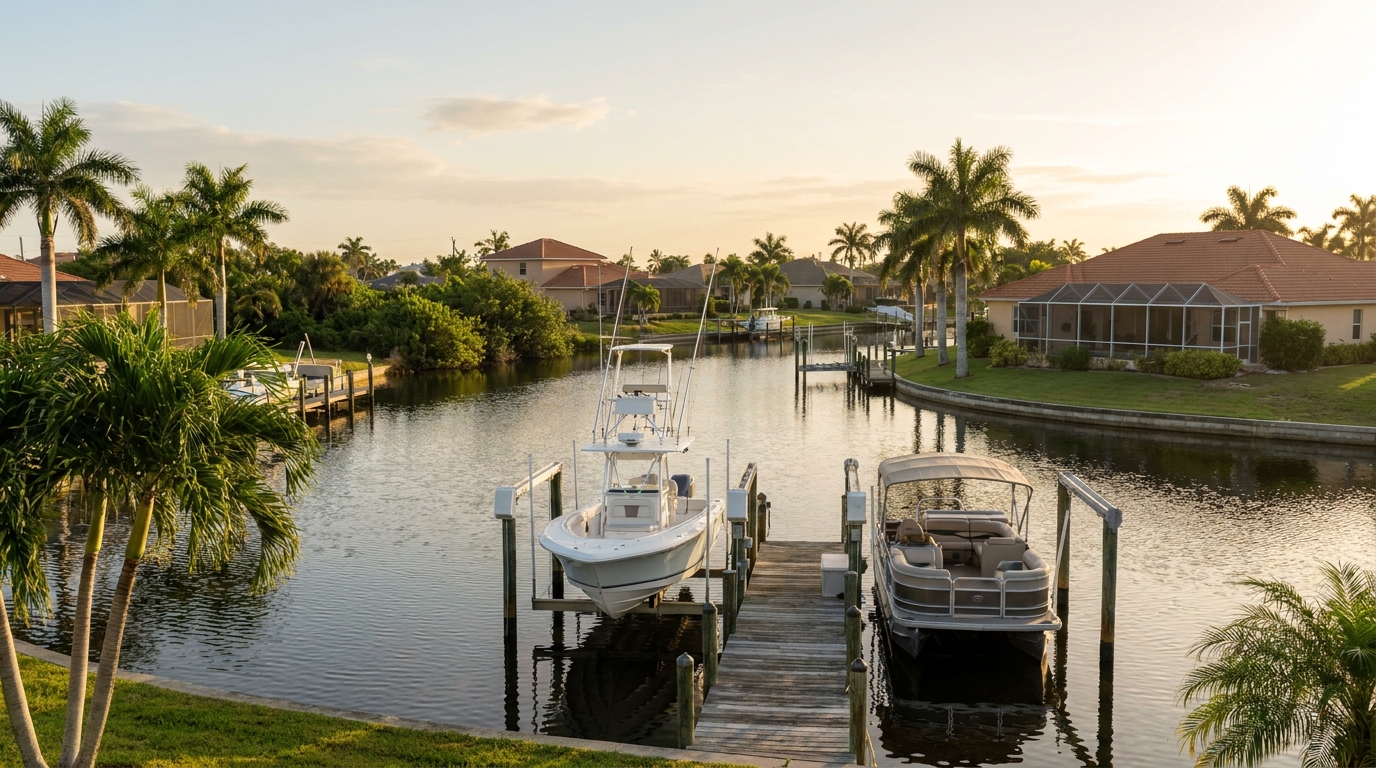
For most Cape Coral buyers, the answer comes down to mission: choose a center console if you plan to fish, run offshore into the Gulf, or cover distance through the passes; choose a pontoon if you want a stable, social platform for sandbar days, sunset cruises, and family time on the canals. Both work here — but they solve very different problems on Southwest Florida water.
Cape Coral is a rare market where this comparison genuinely splits down the middle. The city's 400-plus miles of navigable canals favor calm-water cruising, while direct access to the Caloosahatchee River, Matlacha Pass, and Pine Island Sound opens the door to serious fishing and Gulf runs. At Worldwide Yacht Sales, we walk buyers through this decision every week, and the right answer almost always tracks how — and where — you actually intend to use the vessel.
Which boat handles Cape Coral's waters better?
Center consoles handle Cape Coral's mixed conditions better when you plan to leave the canal system — running Matlacha Pass, crossing Pine Island Sound, or heading offshore into the Gulf. Pontoons handle Cape Coral's waters better when you stay inside the canal network, along the Caloosahatchee, or on protected sandbars where stability and seating matter more than chop performance.
Many coastal-capable center consoles feature V-shaped hulls with meaningful deadrise and bow freeboard, which is what lets them punch through the wind chop that builds on the Sound most afternoons. Pontoons, by design, sit flat on twin or triple aluminum tubes — glorious at rest, less forgiving when a two-foot slop rolls in past the Sanibel Causeway.
How do center consoles and pontoons compare on speed and performance?
Center consoles plane faster, cruise faster, and hold speed better in chop. Pontoons have become more capable in recent product generations, but they remain comfort-first platforms. If your Saturday plan involves reaching Boca Grande before the tide turns, a center console is the tool.
Horsepower ranges illustrate the difference: entry center consoles such as the Stingray 17CC are rated for 90–115 hp and the Stingray 20CC for 150–200 hp, while the SUN TRACKER Party Barge 20 DLX is available with 60 hp or 90 hp engines and a maximum recommended rating of 115 hp. Larger offshore-capable center consoles climb well above 200 hp, with premium models exceeding 400 hp.
Which is better for fishing the backwaters and Gulf?
Center consoles are purpose-built for fishing. The 360-degree deck access around the helm lets anglers work bait, cast, and fight fish from any position — indispensable when you're poling a flat near Matlacha or trolling structure off Sanibel. Pontoons can accommodate casual fishing, but the fenced deck and seating layout limit serious angling. Recreational pontoon layouts prioritize seating over fishing-specific features.
Draft matters too. Shorter center consoles can access the shallow flats and oyster bars that define this coastline in ways that a wide-beam pontoon typically cannot. If skinny-water fishing is a priority, a center console's hull geometry is the more practical tool.
Which is better for family cruising and sandbar days?
Pontoons win decisively for social boating. Wide aluminum-tube platforms create a stable deck that's ideal for children, older passengers, and anyone who values a floating patio over a fishing machine. The SUN TRACKER Party Barge 20 DLX, for example, seats 10 people within a 1,370 lb person weight capacity — and larger recreational pontoon models can accommodate even more passengers.
For a family anchoring at a sandbar off Cayo Costa or drifting the canal system on a warm evening, the pontoon's lounge seating, shade options, and stability at rest deliver an experience center consoles aren't designed to match.
How much do center console and pontoon boats cost in 2026?
Entry-level examples of both types are similarly priced around $33,000 — Carolina Skiff center console examples start in the $32,995–$33,200 range, and the SUN TRACKER Party Barge 20 DLX carries a base price of $32,995 (2027 model, trailer excluded) or $33,595 with a 60 hp engine on the 2026 model (trailer excluded). From that common starting point, center consoles span a dramatically wider range upward, with premium offshore models such as the Sportsman 322 Open reaching $417,385 or more. Pontoons generally top out at a lower ceiling.
| Dimension | Center Console | Pontoon |
|---|---|---|
| Starting MSRP | ~$33,000 (smaller models, e.g., Carolina Skiff) | ~$32,995–$33,595 (SUN TRACKER Party Barge 20 DLX, trailer excluded) |
| Upper price range | $417,385+ (e.g., Sportsman 322 Open) | Significantly lower ceiling than offshore center consoles |
| Typical seating (examples) | 4–9+ people (varies by model) | 10 people (Party Barge 20 DLX); larger models seat more |
| Horsepower (examples) | 40 hp (small models) to 350+ hp (offshore) | 60–115 hp (Party Barge 20 DLX range) |
| Speed (manufacturer estimates) | Varies widely by hull and engine | 18–23 mph (60 hp); 23–29 mph (90 hp) — Party Barge 20 DLX |
| Best-suited use | Fishing, Gulf runs, distance | Sandbars, family cruising, canals |
Prices listed are advertised examples from specific dealers or manufacturers and do not reflect Cape Coral dealer pricing, options, freight, or preparation charges. Boat length, engine choice, and configuration all affect the final out-the-door price. Verify current pricing directly with dealers, as inventory and pricing change frequently.
What should Cape Coral buyers look for in a boat brokerage?
Look for a brokerage with genuine Southwest Florida experience, transparent communication, and end-to-end service that covers financing, inspection, documentation, and — when needed — logistics. Cape Coral's mix of canal-front homeowners, seasonal residents, and out-of-state buyers means the brokerage's process matters as much as the inventory itself.
Worldwide Yacht Sales holds a 4.8-star rating from 28 Google reviews as of May 2026. Customers consistently highlight responsiveness, honesty, and coordination on complex transactions — which reflects how remote and long-distance acquisitions typically get handled, a common scenario for buyers relocating to Cape Coral or shipping a vessel in from another state.
How should Cape Coral's geography shape your decision?
Cape Coral's waterways divide cleanly into two worlds. The Gulf-access canal network — spanning neighborhoods from Cape Harbour to the southeast Rose Garden district — is calm, protected, and ideal for pontoon cruising year-round. Beyond the locks and out through Redfish Point, however, the Caloosahatchee widens and Pine Island Sound opens into conditions that reward a deeper vee and higher freeboard.
Seasonality matters too. Snowbird months from November through April bring the calmest water and the busiest sandbars; summer afternoons bring pop-up storms that punish flat-bottomed hulls; and hurricane season (June 1 through November 30) is when Florida owners should confirm storage, insurance, and haul-out plans well before any named system forms in the Gulf.
Frequently Asked Questions
Is a center console or pontoon better for Cape Coral canals?
Both work well inside Cape Coral's canal system, but pontoons are generally the more comfortable choice for pure canal cruising because their wide, stable deck suits slow, social outings. Center consoles are better if you plan to leave the canals regularly and run into Matlacha Pass, Pine Island Sound, or the Gulf, where their hull design handles chop more capably.
How many people can each boat type carry?
Center console seating varies by model — a small example such as the Boston Whaler 130 Super Sport seats 4, the Stingray 17CC seats 7, and the Stingray 20CC seats 9. Pontoons typically offer higher capacity for their size; the SUN TRACKER Party Barge 20 DLX, for instance, is rated for 10 people within a 1,370 lb person weight capacity. Larger recreational pontoons can accommodate more. All capacity limits on the manufacturer's capacity plate must be observed.
What's the price difference between a center console and a pontoon?
Entry-level examples of both types are similarly priced around $33,000. The SUN TRACKER Party Barge 20 DLX starts at $32,995–$33,595 (trailer excluded), and smaller center console models such as Carolina Skiff examples start in the $32,995–$33,200 range. From that common floor, center consoles span a much wider range upward — premium offshore models can exceed $400,000 — while pontoons generally have a lower price ceiling. Verify current pricing with dealers directly.
Can you fish seriously from a pontoon in Cape Coral?
You can fish casually from a pontoon and many families do — trolling the Caloosahatchee, drifting flats, or bottom-fishing in protected water. For serious inshore or offshore angling, however, a center console is significantly better suited. The 360-degree deck access around the helm allows anglers to move freely around the entire boat, which matters when fighting fish or working structure.
What draft do these boats need for Cape Coral flats?
Draft varies by model for both boat types. Many center consoles in the 17–20 foot range can access Cape Coral's shallower flats and backwater areas more readily than a wide-beam pontoon, whose broad hull and tube configuration generally requires more water depth. If shallow-water access to oyster bars and backwater creeks is a priority, confirm the specific draft of any model you consider before purchasing.
Where can I find center console and pontoon boats for sale near me in Cape Coral?
Buyers searching for a boat near Cape Coral have several avenues, including local brokerages, national listing platforms, and full-service yacht sales firms that handle both new and pre-owned inventory. Worldwide Yacht Sales works with buyers throughout Southwest Florida and coordinates remote purchases, financing, inspection, and shipping — a common need for out-of-state buyers acquiring vessels berthed locally.
Is a pontoon boat safe on Pine Island Sound?
A pontoon can cross Pine Island Sound in calm, protected conditions, but it is not the preferred platform for the afternoon wind chop and open fetch that frequently build there. Pontoons are most at home in canals, rivers, and sheltered bays. If your outings regularly involve Pine Island Sound or runs toward the Gulf, a center console's hull design handles those conditions more reliably. Always check forecasts and observe the manufacturer's capacity and operating guidelines.
Do pontoon boats hold their value as well as center consoles?
Both boat types depreciate, and resale value depends heavily on brand, condition, engine hours, and local demand rather than hull style alone. In Southwest Florida's active boating market, well-maintained examples of either type attract buyers. For guidance on current market values and what to look for in a pre-owned vessel, contact Worldwide Yacht Sales for an assessment based on specific makes and models you are considering.
Choosing the right boat for your Cape Coral life
The center-console-versus-pontoon question isn't really about boats — it's about how you plan to spend your time on the water. Anglers, offshore runners, and speed-focused buyers gravitate to center consoles; families, entertainers, and canal cruisers gravitate to pontoons. In a market as varied as Cape Coral, both categories have earned their place.
Readers in Cape Coral who want experienced guidance through the acquisition, from listing search through financing, inspection, and delivery, can reach Worldwide Yacht Sales at worldwideyachtsalesinc.com or by phone at (727) 346-8229. Whether the next vessel is a nimble center console for Pine Island Sound or a wide-deck pontoon for the canal system, the right match starts with an honest read of how you plan to use it.