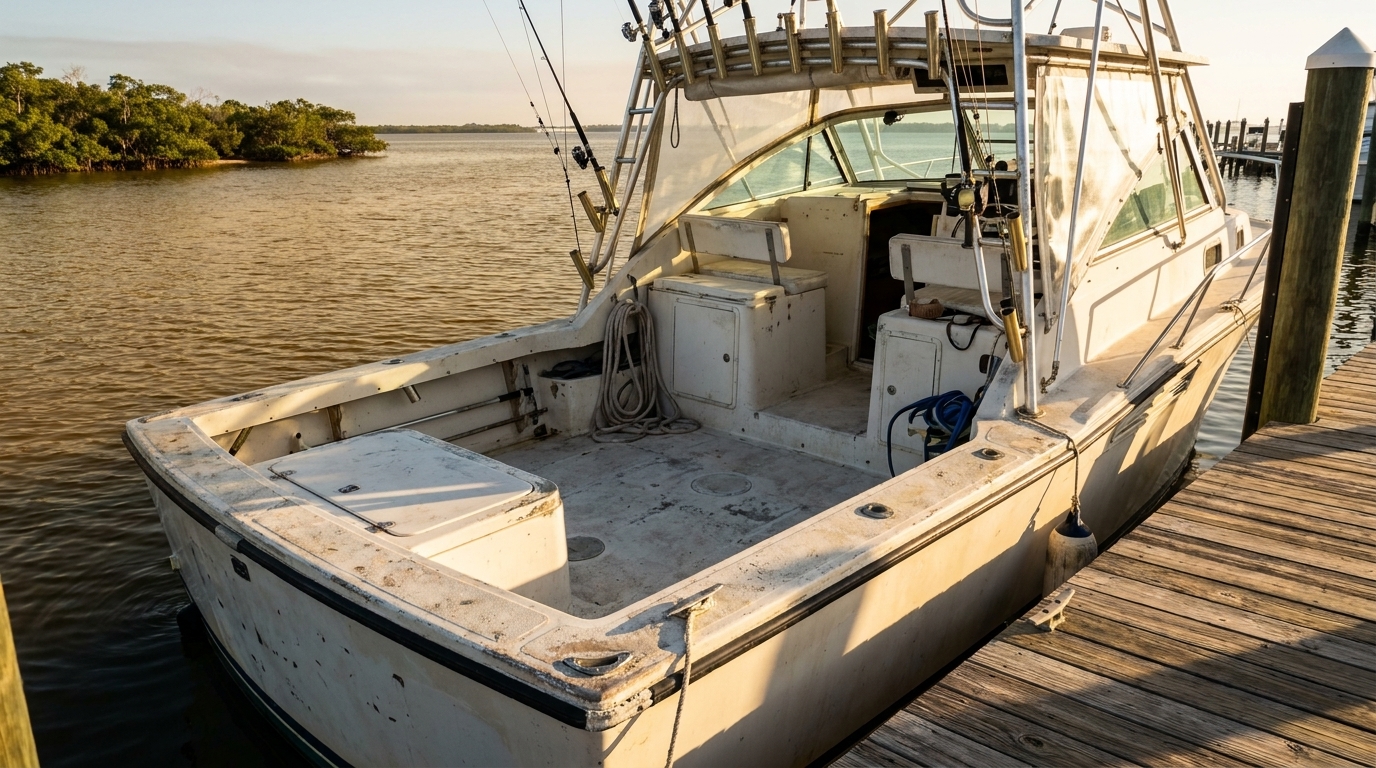
Yacht Broker Tampa, FL: Listing Price Myths in 2026
Tampa boat sellers keep mispricing listings by trusting asking prices, round numbers, and slip premiums. Here's what actually sets a defensible list price.
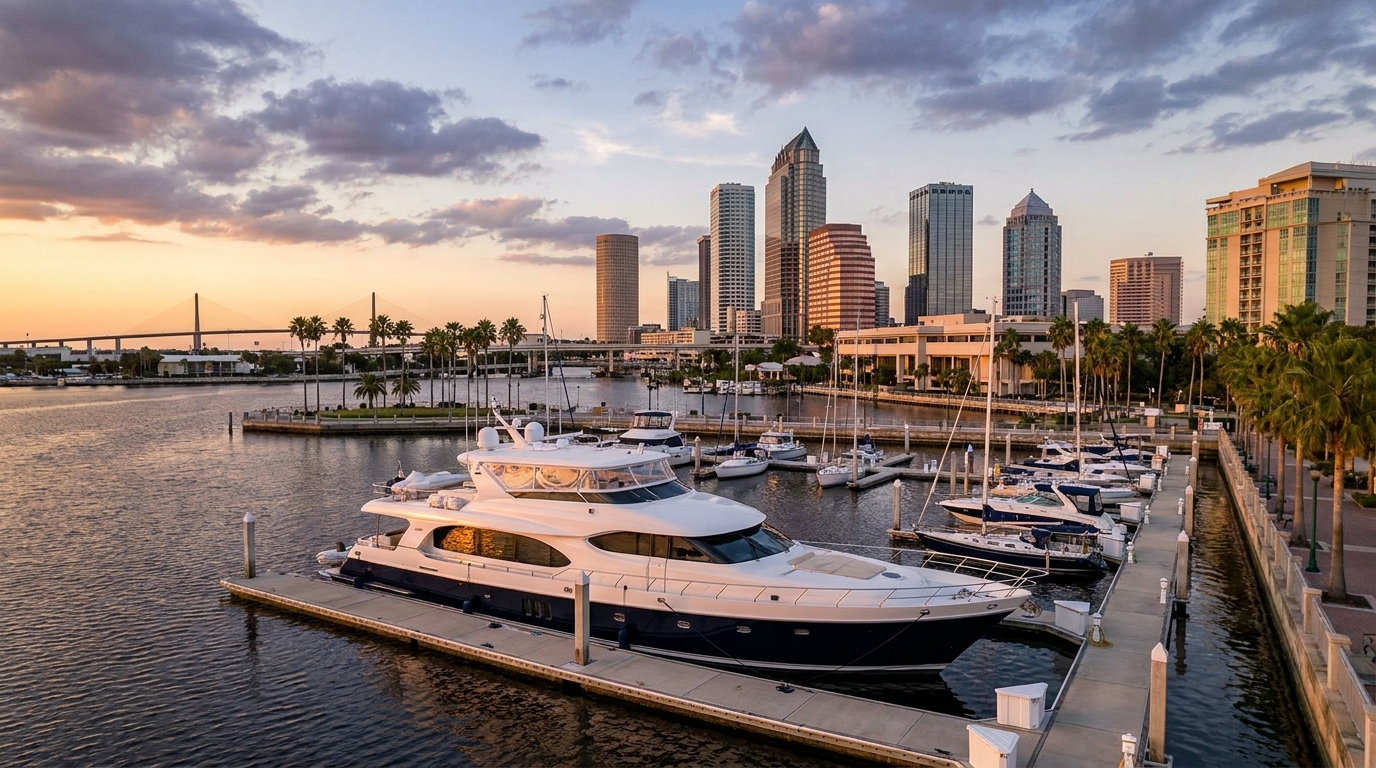
Most Tampa boat sellers arrive at a listing price the wrong way: they average the asking prices of similar boats on the market and add a cushion for negotiation. That produces an inflated number tied to what other sellers hope to get, not what buyers have actually paid. A defensible pre-listing valuation in Tampa Bay is built from recent sold comparables, adjusted for condition, equipment, storm history, and documentation — with an understanding that completed sales in one recent industry market review closed at roughly 90% of asking price.
Why is averaging asking prices the wrong way to value a Tampa boat?
Averaging asking prices anchors the seller to other sellers' wishful thinking, not to closed transactions. Asking data and sold data are different datasets, and in Tampa's segmented brokerage market the gap between them is where listings stall. A recent industry market review found median completed sales at approximately 90% of asking price across two consecutive annual periods — a useful negotiation reference, not a Tampa-specific formula.
The problem compounds when sellers pull comps from national listing sites without filtering for closed sales. A 2026 brokerage dataset reported a $549,000 median asking price and $1.40 million average asking price across 1,732 listings averaging about 51 feet — figures that describe seller hopes across a wide, non-Tampa sample. Using that spread to justify a Gulf Coast list price mistakes the top of the market for the middle of it.
What actually determines what a boat is worth before listing in Tampa?
A defensible pre-listing value comes from matched sold comparables — same make, model, model year, length, propulsion, and layout — then adjusted line by line for engine hours, electronics, generator, air conditioning, bottom condition, survey findings, documentation, and hurricane history. Worldwide Yacht Sales, based at 12781 Kingfish Drive in Treasure Island, works this pricing exercise from closed transactions rather than from active listings, which is the only way to produce a number a buyer's surveyor will support.
Tampa's market segments cleanly. Boats under $50,000 tend to be entry-level runabouts, older center consoles, and vessels needing work. The $100,000–$250,000 band is the market's central volume, per that same industry review, followed by $250,000–$500,000 for higher-specification center consoles, newer cruisers, and quality sailing yachts. Above $500,000, buyer pools shrink and marketing periods lengthen even when dollar volume remains firm.
Why do sellers overprice, and what does it cost them?
Sellers overprice because they conflate three different numbers: what they paid, what they owe, and what the boat is worth today. None of those set market value. An inflated opening price suppresses inspections during the strongest buying weeks, and a boat that goes stale after peak season typically has to be recut below what a realistic opening number would have produced.
The category-level data reinforces the caution. One industry report noted the yacht and cruiser category down 6.8% on its trailing 12-month measure, representing 4,515 units.
How should hurricane season and Tampa's climate factor into the price?
Storm exposure is a valuation issue, not a disclosure footnote. The Atlantic hurricane season runs June 1 through November 30, and a boat with documented pre-storm haul-outs, secure storage, post-storm inspections, and unbroken insurance and service records will price and sell more easily than an otherwise identical boat with gaps in the file. Buyers and their surveyors read those gaps as risk.
Saltwater corrosion, UV exposure, and bottom growth compound the point. Engine-room photographs, corrosion inspections, recent surveys, and generator logs are not paperwork — they are the evidence that supports the top of a price range instead of the bottom. Boats berthed anywhere from St. Petersburg and Clearwater through Tampa Bay and down to Bradenton face the same climate load; the vessels that hold value are the ones whose records prove it was managed.
How much of a premium can a Tampa slip or location actually add?
Location can produce a real premium or discount independent of the hull, but claimed "slip value" should not be added automatically to a list price. Marina agreements in the Tampa Bay area are often nontransferable, subject to approval, or priced separately from the vessel. What genuinely adds value is easy inspection and sea trial access — proximity to Gulf passes, Tampa Bay, and the Intracoastal Waterway — not a slip number written into the listing.
Category matters here too. Center consoles and bay boats benefit from Tampa Bay fishing and island-hopping access. Express cruisers gain from weekend range to coastal destinations. Trawlers and larger cruising yachts are valued for range, draft, and redundancy suitable for extended Gulf travel. Sailboats and catamarans attract offshore-minded buyers but are sensitive to rigging age and hurricane-storage history — one market review noted a median sailing-catamaran sale near $380,000 versus roughly $90,000 for a sailing monohull.
What does the Tampa pricing landscape look like at a glance?
The table below reflects the indicative pre-listing bands identified in a recent industry market review. These are market reference ranges for pricing conversations, not formal appraisals, and any specific vessel can price above or below its band based on condition and documentation.
| Price band | Typical Tampa segment | Marketability notes |
|---|---|---|
| Under $50,000 | Entry-level runabouts, older center consoles, project boats | Roughly 50–55 annual sales in the reviewed market; condition-sensitive |
| $50,000–$100,000 | Well-kept smaller powerboats, older express cruisers, some sailboats | Documentation and hours drive the spread |
| $100,000–$250,000 | Late-model center consoles, sport boats, cruisers | Central volume band in the reviewed market |
| $250,000–$500,000 | Higher-spec center consoles, newer cruisers, quality sailing yachts | Smaller buyer pool; dollar volume can remain firm |
| Above $500,000 | Larger or newer yachts, premium builders, motor yachts | Firm dollar demand, smaller buyer pool, longer marketing periods |
What licensing rules apply to Tampa yacht listings in 2026?
Florida regulates yacht brokerage specifically under Florida Statutes Chapter 326, the Yacht and Ship Brokers' Act. That chapter generally covers brokerage of a "yacht" defined as a pleasure vessel over 32 feet in length, and a person acting as broker or salesperson in a covered transaction generally must hold the required Florida license unless a statutory exemption applies — the search results identify an exemption for the sale of a new yacht.
The 32-foot threshold matters for sellers choosing representation. Above it, Chapter 326's licensing, escrow, and related obligations apply; at or below it, other state and federal requirements may still govern the transaction. Sellers should verify current requirements through Florida's Department of Business and Professional Regulation before signing a listing agreement.
Frequently asked questions
How much is my boat worth before listing in Tampa?
A pre-listing value is built from recent sold comparables of the same make, model, year, length, and propulsion, adjusted for engine hours, equipment, condition, documentation, and storm history. Tampa's brokerage market segments broadly from under $50,000 through above $500,000, with $100,000–$250,000 identified as the central volume band in a recent industry market review. Asking-price averages are not a substitute for closed-sale data.
Is a free boat valuation in Tampa actually reliable?
A no-cost broker's pricing opinion can be reliable when it is built from verified sold comparables rather than active listings, and when it accounts for condition, equipment, and storm history. It is not the same as a certified marine appraisal, which insurance, estate, financing, and litigation purposes may require from a qualified marine surveyor. For pre-listing decisions, a comparative market analysis from a licensed broker is usually the right tool.
What commission do yacht brokers take in Florida?
Yacht brokerage commissions in Florida are negotiated in the central listing agreement and vary by vessel value, marketing scope, and co-brokerage arrangements. There is no statutory rate. Sellers should ask any broker to disclose the commission structure, co-broker split, and escrow handling in writing before signing, and should verify that the broker holds the license required under Florida Statutes Chapter 326 for vessels over 32 feet.
How should I price a boat for sale if comparable listings vary widely?
Separate asking prices from closed sales, then weight closed sales more heavily. Adjust for engine hours, generator, electronics, air conditioning, bottom condition, survey findings, deferred maintenance, and hurricane history. One recent industry review found median completed sales at roughly 90% of asking price, so an opening list price only slightly above the supported sold range typically generates more inspections than an aggressive number set to "leave room to negotiate."
Does a Tampa slip or marina location increase my listing price?
Location can add or subtract value, but a slip should not be added automatically to a list price. Many Tampa Bay marina agreements are nontransferable or subject to approval, and buyers price a berth separately. What genuinely helps a listing is easy access for inspection and sea trial, proximity to Gulf passes and the Intracoastal, and documentation that the vessel has been maintained in a saltwater environment.
How long does it take to sell a Tampa boat at the right price?
Marketing periods depend on price band, condition, and season. Competitively priced, well-documented boats in the $100,000–$250,000 central band tend to move faster than boats above $500,000, where the buyer pool is smaller. Listing before the strongest buying weeks and outside of active hurricane threats generally produces more inspections. A materially inflated opening price extends the timeline and usually forces a price cut below what a realistic number would have achieved.
What paperwork should I have ready before setting a list price?
A defensible valuation file includes title, registration, and documentation records; lien information; a recent marine survey; engine and generator surveys where appropriate; verified engine hours; maintenance invoices; hurricane, haul-out, and insurance-claim history; and photographs of engines, bilges, electronics, hull, and running gear. Sellers should also assemble sold comparables — not just active listings — so the asking price is anchored to closed transactions.
The bottom line for Tampa sellers
The central pricing risk in Tampa Bay is not a shortage of boats; it is confusing active asking prices with realizable value. Market bands and the roughly 90% asking-to-sale relationship in one industry dataset are useful starting references, but the vessel-specific number still requires verified sold comparables and a condition-based inspection. Tampa sellers who want this handled professionally can contact Worldwide Yacht Sales at https://worldwideyachtsalesinc.com or (727) 346-8229 to work through a pre-listing valuation grounded in closed-sale data rather than in what other sellers are asking.