Motor Yacht vs Sailing Yacht in Seattle, WA: 2026 Guide
Choosing between a motor yacht and sailing yacht for Puget Sound? Compare speed, cost, and cruising fit for Seattle waters — with expert buyer guidance.
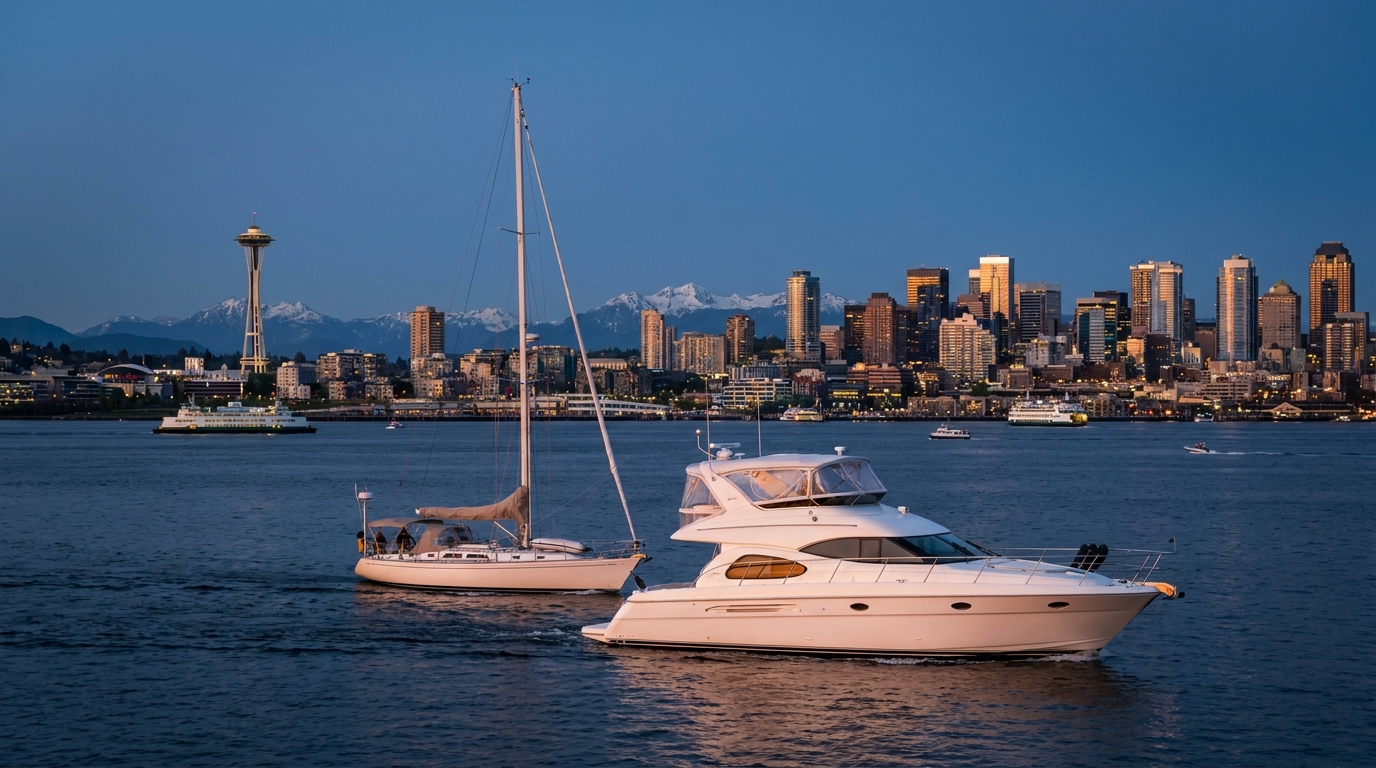
For most Puget Sound buyers, a motor yacht is the better fit if you value fast weekend hops to the San Juans, generous interior volume, and straightforward operation — the Maritimo M55, for example, cruises comfortably at 18–25 knots on twin Volvo D11 diesels. A sailing yacht is the stronger choice if you want lower fuel burn, a more hands-on seamanship experience, and are comfortable working with Puget Sound's prevailing southerly winds and strong tidal currents. The right answer hinges less on the boat and more on how you actually intend to spend your time on the water.
Puget Sound is one of the most rewarding cruising grounds in North America — but it's also one of the most demanding. Ebb currents through Deception Pass, wind funnels near Admiralty Inlet, and the summer procession of vessels heading north to the San Juans and Gulf Islands reward vessels chosen with intent. Below, we walk through the decision the way our team at Worldwide Yacht Sales walks through it with clients: dimension by dimension, honest about the tradeoffs.
How do motor yachts and sailing yachts differ for Puget Sound cruising?
The core difference is propulsion philosophy. A motor yacht like the Maritimo M55 runs on twin engines — in that model, 2 x Volvo D11 diesels at 670 MHP each — giving you 15–35+ knot cruising and complete independence from wind. A sailing yacht such as the Beneteau Oceanis 38 relies on sails for primary propulsion, with a Yanmar 3YM30E diesel as auxiliary, cruising typically at 5–8 knots and using far less fuel when the wind cooperates.
In Puget Sound, where summer southerlies build reliably through the afternoon and winter systems push through from the southwest, both propulsion styles have their moments. What differs is who's doing the work — the diesel, or you.
Which is faster and better for weekend trips to the San Juans?
Motor yachts win decisively on speed. A 15–35+ knot motor yacht can cover the roughly 80 nautical miles from Shilshole Bay to Friday Harbor in a long half-day; a sailing yacht at 5–8 knots is looking at a full day, often two, especially working against a flood tide through Admiralty Inlet. For buyers whose calendar is the binding constraint, that difference is everything.
Motor yachts are significantly faster, which matters for maximizing time at anchor or island-hopping on short weekend windows in Puget Sound. If your typical trip is Friday-afternoon-out, Sunday-evening-back, a planing motor yacht turns a marginal weekend into a real one.
What are the real cost differences between motor and sailing yachts?
Sailing yachts win on both purchase price and ongoing cost. In the 40–50 ft range, sailing yachts run roughly $300,000–$900,000 across the used and new broad market, versus $500,000–$1.5M+ for comparable motor yachts. Annual maintenance for sailing yachts is estimated at 5–8% of purchase price; motor yachts run 8–12%.
Fuel is the other lever. A sailing yacht under sail uses no diesel; a motor yacht is on the engines every hour underway. The Maritimo M55 has a starting MSRP of US$2,056,000 as a representative luxury example. For equivalent interior volume, motor yachts generally cost 20–30% more to purchase than sailing yachts.
| Dimension | Motor Yacht (Maritimo M55 example) | Sailing Yacht (Oceanis 38 / Oyster 565) |
|---|---|---|
| Cruising speed | 15–35+ knots (typically 18–25) | 4–12 knots (typically 5–8) |
| Engine | 2 x Volvo D11 – 670 MHP | Yanmar 3YM30E (29 HP) / Yanmar 4LV-150 (150 HP) |
| Purchase price (40–50 ft) | ~$500,000–$1.5M+ | ~$300,000–$900,000 |
| Annual maintenance | 8–12% of purchase price | 5–8% of purchase price |
| Sleeping capacity (example) | 6 in 3 cabins (M55) | 2 private staterooms (Oceanis 38) |
| Ease of operation | Easier, less weather-dependent | Skill-intensive, weather-aware |
How do Puget Sound's winds and tidal currents affect the choice?
Puget Sound rewards vessels chosen for its specific conditions. Prevailing summer southerlies make afternoon sails northbound genuinely fun, but the region's strong tidal currents — particularly through Deception Pass, the Tacoma Narrows, and the approaches to the San Juans — regularly hit 4–6 knots. That matters more for a sailing yacht cruising at 5–8 knots than for a motor yacht at 20+.
Winter here is another story: gray, wet, and often windless, with systems that arrive fast. Motor yachts handle shoulder-season and winter cruising with less schedule risk. Sailing yachts shine May through September, when the wind pattern is predictable enough to plan around.
Which is easier to operate for a first-time buyer?
Motor yachts are meaningfully easier for buyers without a sailing background. Operation centers on throttle, helm, and navigation — skills that transfer well from powerboating and can be built with a competent captain's coaching over a season. Sailing yachts add sail handling, trim, points of sail, reefing decisions, and constant weather awareness to the picture.
For PNW buyers coming from powerboats or from no boating at all, we typically point them toward motor yacht or trawler-style vessels for straightforward operation. Buyers with sailing experience — or the appetite to learn — often find the Sound's conditions ideal for building real seamanship.
What's the right choice for entertaining versus scenic cruising?
Motor yachts offer more interior volume and taller accommodations for the same length, thanks to wider beams and no rigging or deep keel intruding on the layout. The Maritimo M55 sleeps 6 across 3 cabins in a package built for hosting — flybridge, cockpit lounging, saloon volume. Sailing yachts trade that volume for hull efficiency; the Oceanis 38's 2 private staterooms and single head with separate shower are cozy by comparison.
If your vision is Sunday brunch anchored off Blake Island with eight friends, motor yacht. If your vision is heeled over on a beam reach with the Olympics on the horizon, sailing yacht. Both are legitimate Puget Sound experiences — they just aren't the same experience.
How should you work with a broker on this decision?
The broker's job is to translate your actual cruising plans into the right hull, not to sell you the boat with the best margin. That means asking hard questions about how many weekends you'll really use it, who's coming aboard, whether you want to sail or arrive, and what your tolerance is for maintenance work versus writing checks. It also means honesty about resale — motor yachts and sailing yachts trade in different market cycles.
Worldwide Yacht Sales works with clients to provide responsiveness and no-pressure guidance through complex acquisitions.
Frequently Asked Questions
Is a motor yacht or sailing yacht better for the San Juan Islands?
Motor yachts are generally better for short San Juan Islands trips because they can cover the roughly 80 nautical miles from Seattle at 15–35+ knots, reaching Friday Harbor in half a day. Sailing yachts at 5–8 knots suit longer, more leisurely cruises where the passage itself is part of the experience. Both work well; the question is your time budget.
How much does a 40–50 ft yacht cost in the Seattle market?
In the 40–50 ft range, motor yachts run roughly $500,000–$1.5M+ across the used and new broad market, while sailing yachts fall around $300,000–$900,000. Pricing varies heavily by age, build quality, and equipment. A representative luxury motor yacht like the Maritimo M55 starts at US$2,056,000 MSRP. Local market conditions in Puget Sound may adjust these ranges.
What are the annual operating costs for a yacht in Puget Sound?
Annual maintenance is generally estimated at 8–12% of purchase price for motor yachts and 5–8% for sailing yachts, based on general industry figures. Motor yachts also carry higher fuel costs because they depend on continuous engine use, while sailing yachts burn diesel only when the auxiliary is running. Moorage, insurance, and haul-out costs in Seattle are additional and vary by marina.
Do I need sailing experience to buy a sailing yacht?
You don't need sailing experience to buy one, but you'll need to build it to operate one safely on Puget Sound. Sailing yachts require sail handling, weather awareness, and comfort with the region's strong tidal currents and shifting winds. Many buyers take ASA courses or hire a captain for the first season. Buyers without that appetite are usually better served by a motor yacht.
Which type holds its value better?
Both motor and sailing yachts depreciate, and resale depends more on build quality, maintenance history, and market timing than on propulsion type. Well-maintained brands in either category from reputable builders tend to hold value best. In the Pacific Northwest, cruising-capable vessels — whether sail or power — with documented service records typically resell more predictably than heavily customized or neglected boats.
How long does buying a yacht in Seattle typically take?
The full acquisition process — from initial search through survey, sea trial, closing, and documentation — can take considerable time for a used vessel and longer for a new build. Remote transactions, financing complexity, and survey findings can extend the timeline. Working with an experienced broker streamlines coordination between surveyors, lenders, insurers, and documentation agents.
The bottom line for Puget Sound buyers
The motor-versus-sail question isn't really about boats — it's about how you want to spend Saturday. If Saturday is beating the ferry to Friday Harbor and hosting friends on the flybridge, buy a motor yacht. If Saturday is trimming the main on a long reach with the Olympics off the port bow, buy a sailing yacht. Both are excellent Puget Sound lives.
Readers in Seattle who want an honest, unhurried walk through this decision can reach Worldwide Yacht Sales at worldwideyachtsalesinc.com to talk through cruising plans, budgets, and the specific vessels worth seeing on the water this season.