Motor Yacht vs Sailing Yacht: Which Should You Buy in Seattle?
Motor yacht vs sailing yacht in Seattle: compare speed, cost, range, and PNW suitability to choose the right vessel for Puget Sound and the San Juans.
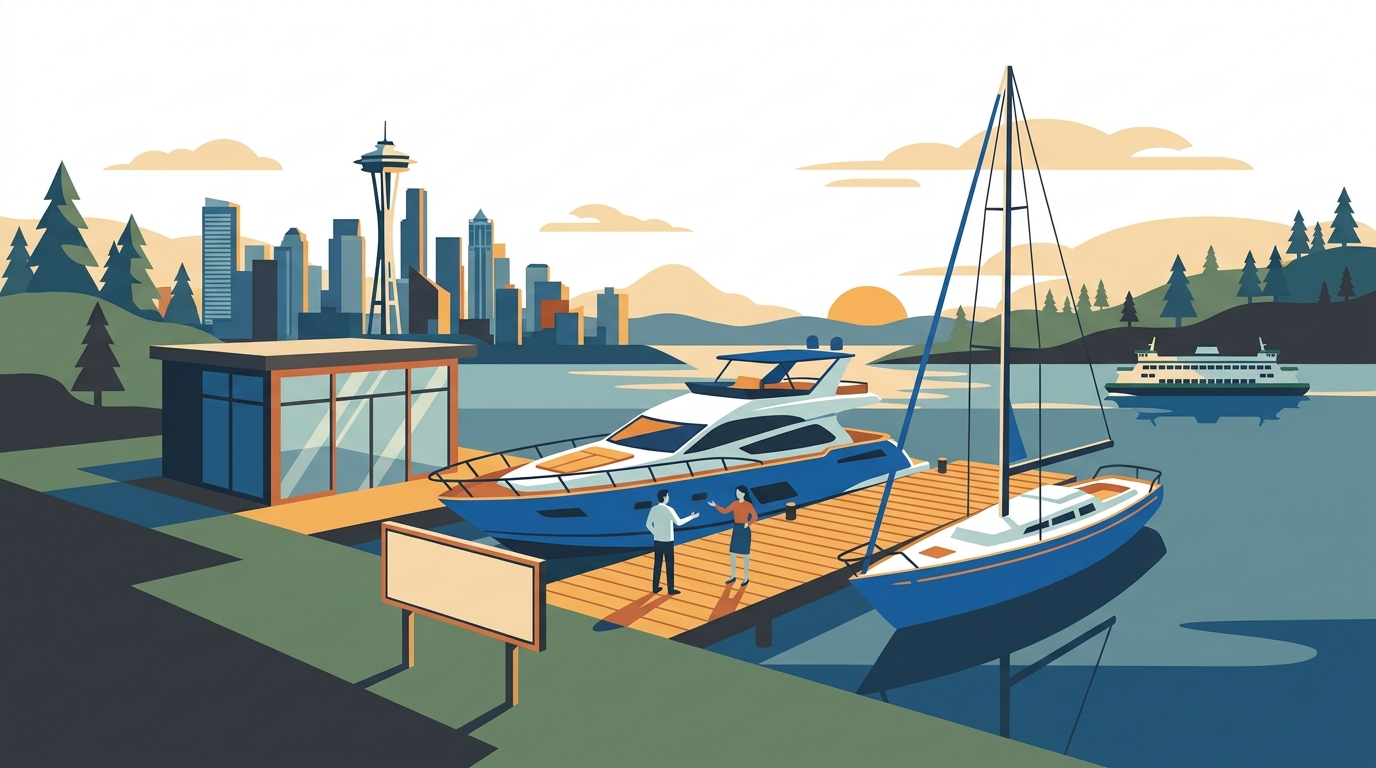
You've spent enough weekends looking out at Elliott Bay to know you want a yacht of your own. The harder question is what kind. Should you buy a motor yacht that can push you to Friday Harbor before Saturday brunch, or a sailing yacht that lets you shut down the engine and ride the westerlies through Rosario Strait? In Seattle, the answer isn't universal — it depends on how you actually cruise the Pacific Northwest.
Here's an honest, side-by-side look at how motor yachts and sailing yachts compare for a Puget Sound owner, and how to think through the decision before you sign a purchase and sale agreement.
The Short Answer for Seattle Buyers
Motor yachts win on speed, interior volume, and ease of operation. Sailing yachts win on fuel economy, range, and lower ongoing costs. For a Seattle professional who wants fast weekend runs to the San Juan Islands with guests aboard, a motor yacht is usually the better fit. For an owner planning extended cruises to Desolation Sound, the Broughtons, or Southeast Alaska — or one drawn to Duck Dodge Tuesday nights on Lake Union — a sailing yacht earns its keep.
Both platforms suit Puget Sound. The right choice comes down to time budget, operating budget, and whether the journey or the destination is the point.
Cruising Speed and How It Changes Your Weekends
A planing motor yacht around 40 feet cruises at 18 to 25 knots, with top speeds pushing 28 to 35 knots on the right hull. A comparable sailing yacht moves at 5 to 7 knots under sail, with top speeds around 8 to 10 knots in ideal conditions.
The practical difference for a Seattle owner is real. Shilshole Bay to Friday Harbor covers roughly 85 nautical miles. Under power at cruise, that's a four-to-five-hour run — leave Friday after work, dock in time for dinner. Under sail, plan on 12 to 18 hours and a strategy for Deception Pass or the Strait of Juan de Fuca current windows.
If your typical trip is Seattle to the San Juans and back over a weekend, speed matters. If you have a week or more and want to sail rather than commute, it doesn't.
Fuel, Maintenance, and the True Cost of Ownership
Purchase price is the opening bid. Ongoing cost is where the real gap lives.
Fuel Burn
A 42-foot motor yacht burns roughly 5 US gallons per hour at 9 knots on a full-displacement hull, around 12 gallons per hour at 17 knots on a semi-displacement hull, and about 24 gallons per hour at 30 knots on a planing hull. A mid-size sailing yacht under auxiliary power burns roughly 0.8 to 1.3 gallons per hour at 5 to 6 knots — and effectively nothing under sail.
With Seattle marine diesel prices what they are in 2026, that difference compounds fast across a season of weekend trips.
Annual Operating Costs
Industry rules of thumb put motor yacht annual operating costs at roughly 8 to 12 percent of purchase price. Sailing yachts typically run 5 to 8 percent. The gap reflects fuel, more complex mechanical systems, generators, stabilizers, and specialist maintenance. These are general estimates — actual costs vary with vessel age, complexity, moorage, and how much of the work you do yourself.
Purchase Price
Comparable-length coastal cruiser motor yachts run roughly $350,000 to $900,000 new, with 24-to-50-meter yachts spanning $1 million to $35 million and up. Mid-size cruising sailboats run about $200,000 to $400,000 new; larger pre-owned sailing yachts in the 24-to-40-meter range fall between $500,000 and $10 million. Sailing yachts generally carry lower acquisition costs at similar length.
Range and the Pacific Northwest Cruising Ground
Range is where sailing yachts quietly dominate. A similar-size planing motor yacht typically has 150 to 300 nautical miles on main tanks. A sailing yacht routinely covers 500-plus nautical miles combining sail and auxiliary; larger sailing yachts manage 1,500 to 3,000 nautical miles under power alone, and effectively unlimited range with wind.
For a Seattle owner whose horizon includes Princess Louisa Inlet, the Broughton Archipelago, or the Inside Passage to Ketchikan, that autonomy matters. Fuel docks thin out fast north of Port McNeill. A sailing yacht turns a fuel constraint into a wind opportunity.
Interior Volume, Comfort, and Guests Aboard
Motor yachts offer roughly 30 to 40 percent more interior volume and deck space at the same length overall. Flybridges, larger saloons, and tender garages become feasible. Sailing yachts run closer to 60 to 70 percent of that volume — narrower hulls and rig loads limit the beam and the layout.
Underway, a motor yacht rides largely level, often with stabilizers on larger boats. A sailing yacht heels 15 to 25 degrees when the wind's up, which is part of the appeal for sailors and a deal-breaker for guests prone to seasickness. Puget Sound's wind-against-tide chop through Admiralty Inlet or the Tacoma Narrows amplifies that motion.
If entertaining clients or hosting extended family is central to how you'll use the boat, the motor yacht platform is the more forgiving host.
Operation and the Skill Curve
Motor yachts require moderate skill — throttle discipline, close-quarters handling, current awareness, and radar work in Puget Sound fog. Sailing yachts add sail trim, reefing decisions, weather routing, and heel management. Both reward training; the sailing yacht demands more of it.
Washington doesn't require a recreational operator license for private yachts, but a Washington State Boater Education Card is required for operators of motorized vessels 15 horsepower and above. For yacht-scale vessels, most Seattle owners go well beyond that minimum with formal training through local schools before taking delivery.
What Size Yacht Do You Need for Overnight Cruising in Seattle?
For weekend overnights in the San Juans with a couple or a small family, a 35-to-45-foot motor yacht or a 38-to-48-foot sailing yacht is a comfortable starting point. Both give you real staterooms, standing headroom, a working galley, and enough tankage for a four-day trip without dockside water.
For extended cruising to British Columbia or Alaska, most Seattle owners land in the 48-to-65-foot range — the point at which fuel capacity, tankage, and accommodations support two-week-plus voyages with guests aboard.
New vs Used: Which Is the Better Buy in Seattle?
Used yachts dominate the Seattle market for good reason. Depreciation on new motor yachts is steep in the first three to five years, and a well-maintained pre-owned vessel with recent surveys, updated electronics, and documented service history often delivers 80 percent of the experience at a fraction of the price.
New builds make sense when you want specific customization, warranty coverage on hull and machinery (terms vary by builder and are negotiable on custom builds), and the latest systems. For most first-time Seattle owners, a carefully surveyed used yacht from a reputable broker is the smoother entry point.
Whichever direction you go, a pre-purchase survey by a SAMS or NAMS-accredited surveyor, a sea trial in representative Puget Sound conditions, and an engine survey are non-negotiable.
Frequently Asked Questions
Can I sail year-round in Seattle?
Yes, though winter cruising demands proper heating, dehumidification, and heavy-weather gear. Most owners cruise heavily from May through October and use shoulder-season weekends selectively.
Do I need a captain's license to own a yacht in Seattle?
Not for private recreational use. A USCG captain's license is only required if you're operating commercially — charter, instruction, or paid passenger service.
Where do most Seattle yacht owners moor?
Shilshole Bay Marina, Elliott Bay Marina, and various Lake Union and Lake Washington moorages are the primary options. Waitlists at desirable slips can run long, so start that conversation early in the buying process.
Is a motor-sailer a reasonable compromise?
For some buyers, yes — motor-sailers trade peak sailing performance for stronger auxiliary power and better interior volume. They're a niche category worth exploring if you like the idea of sailing but want motor-yacht comfort.
Making the Call
Buying a yacht in Seattle is a decision about how you want to spend your time on the water, not just what you want to own. If your calendar favors fast weekends and guest-friendly cruising, a motor yacht fits. If you value the craft of sailing, lower operating costs, and true range for extended Pacific Northwest passages, a sailing yacht rewards the commitment.
Seattle buyers who want experienced guidance through the search, survey, and negotiation process can reach Worldwide Yacht Sales at worldwideyachtsalesinc.com. The team works across both motor and sailing yacht inventories and knows the Puget Sound cruising ground well enough to help you match the vessel to the life you actually plan to live aboard it.