Yacht Broker Fees in Florida: Palm Harbor, FL Guide
What sellers and buyers actually pay in Florida yacht broker commissions — the standard 10% rate, co-broker splits, and Palm Harbor market context.
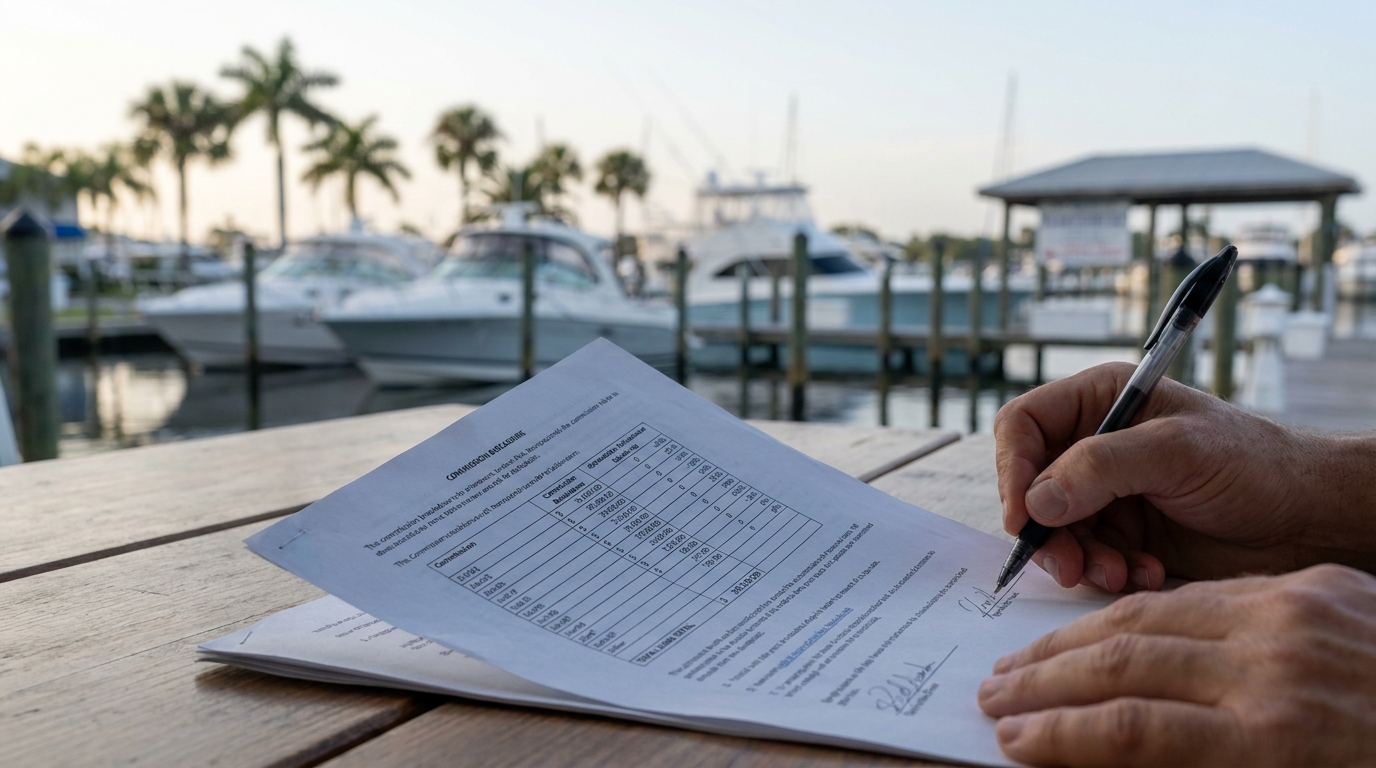
In Florida, yacht brokers typically charge 10% of the final sale price, paid by the seller at closing. When a cooperating buyer's broker is involved, that 10% is commonly split 50/50 or 60/40 between the listing and buyer's brokers. Buyers usually pay no separate broker fee — their representation is funded from the seller's commission.
How much does a yacht broker charge in Florida?
The industry-standard yacht broker commission in Florida is approximately 10% of the final sale price, paid entirely by the seller at closing. There is no Florida statute that fixes this rate — it's a negotiated norm codified in each listing agreement. On lower-priced vessels, minimum brokerage fees may apply, which can push the effective percentage higher than 10%.
That 10% covers the full brokerage service arc: pricing analysis, professional listing and photography, MLS syndication, showings, sea trials, offer negotiation, escrow coordination, and closing documentation. For Palm Harbor sellers listing a vessel on the Gulf Coast, that means the broker's fee scales with the boat's value rather than the hours worked — a structure that aligns broker incentives with achieving a strong sale price.
Worldwide Yacht Sales, based in the Palm Harbor and greater Tampa Bay area, works within this standard Florida framework while handling the full range of vessels crossing the Gulf Coast market — from center consoles headed inland to cruisers moving between coasts.
Who actually pays the yacht broker fee in a Palm Harbor sale?
The seller pays the entire broker commission at closing in a Florida yacht transaction. The buyer does not write a separate check to a broker — even when a dedicated buyer's broker represents them, that broker is compensated from the seller's 10% commission through a co-brokerage split. This makes buyer representation effectively free to the buyer.
This structure is worth pausing on if you're on the buying side in Palm Harbor. Because your broker's fee comes out of the seller's proceeds, you can retain professional representation — someone who tours boats with you, orders surveys, negotiates on your behalf, and manages closing logistics — at no direct cost to you. It's one of the more buyer-friendly conventions in any large-asset transaction.
How does the co-broker split work?
When two brokers are involved — one representing the seller (the listing broker) and one representing the buyer — the 10% commission is split between them. The most common arrangements in Florida are a 50/50 split (5% to each side) or a 60/40 split favoring the listing broker. The seller still pays a single 10% commission; the division happens between the brokerages, not on top of the seller's cost.
Here's how those splits typically pencil out:
| Scenario | Total Commission | Listing Broker Share | Buyer's Broker Share | Paid By |
|---|---|---|---|---|
| Sole broker (no co-broker) | 10% of sale price | 10% | — | Seller at closing |
| Co-brokered, 50/50 split | 10% of sale price | ~5% | ~5% | Seller at closing |
| Co-brokered, 60/40 split | 10% of sale price | ~6% | ~4% | Seller at closing |
The takeaway: sellers should not fear co-brokerage. A cooperating buyer's broker often brings a qualified, pre-vetted buyer with financing lined up — expanding the pool without increasing the seller's cost.
What do Palm Harbor sellers actually get for that 10%?
A full-service Florida yacht broker earns the 10% by handling marketing, qualified buyer screening, sea trials, survey coordination, negotiation, escrow, documentation, and closing. On the Gulf Coast, brokers also manage vessel logistics — dockage arrangements, haul-outs at local yards, and, frequently, out-of-state shipping to buyers in the Northeast or inland states.
The Palm Harbor market has some specific dynamics worth naming. Listings often peak in demand during snowbird months from roughly November through April, when out-of-state buyers are physically in Florida and touring vessels along the Pinellas coast. Hurricane season, running June through November, introduces insurance and haul-out considerations that a local broker manages as part of the listing process. A broker who knows the Tampa Bay yards, the Anclote River access, and Coast Guard documentation workflows saves the seller weeks of coordination.
That remote-buyer capability matters in a market where a meaningful share of Palm Harbor listings sell to buyers who live somewhere else entirely.
Are yacht broker fees negotiable in Florida?
Yes. Florida law does not fix broker commission rates, so the 10% figure is a market convention, not a statute. On higher-value vessels — say, a well-priced cruiser or sportfish — sellers sometimes negotiate a lower percentage, or negotiate the co-broker split arrangement. Any deviation should be documented in the signed listing agreement before the boat goes to market.
Two cautions. First, minimum brokerage fees may apply on lower-priced boats, which can lift the effective rate above 10%. Second, aggressive discounting can reduce marketing spend and buyer's-broker cooperation — a boat listed at a discounted commission may see fewer showings from cooperating brokers who prioritize standard-commission listings. The lowest fee is not always the highest net to the seller.
What other costs should Florida sellers and buyers expect?
Beyond the broker commission, sellers typically absorb haul-out and survey-prep costs if the buyer's survey requires it, plus any pre-listing detailing or minor repairs. Buyers cover their own survey (usually a few hundred to a few thousand dollars depending on vessel size), sea trial fuel, and Florida sales/use tax where applicable, along with title and registration transfer fees through the Florida Department of Highway Safety and Motor Vehicles or a documentation service for USCG-documented vessels.
Charter management brokerage runs on a different fee structure entirely and is not reflected in the standard 10% sale commission. If your vessel is currently in charter or you're evaluating a charter-managed boat for purchase, ask the broker to walk through those numbers separately.
Frequently asked questions
Is the 10% yacht broker commission in Florida required by law?
No. Florida has no statute setting yacht broker commission rates. The 10% figure is an industry convention that appears in most Florida listing agreements, but the actual rate is negotiated between the seller and the brokerage before the listing goes live. Sellers can propose alternative rates, though deviating far from the norm can affect co-broker cooperation and marketing reach.
Does the buyer pay anything to their yacht broker in Palm Harbor?
Typically no. In a standard Florida yacht transaction, the buyer's broker is compensated through a co-brokerage split funded entirely from the seller's 10% commission. The buyer pays for their own survey, sea trial fuel, sales or use tax, and title and registration costs — but no direct fee to their broker for representation, negotiation, or closing coordination.
How is the 10% commission split between two brokers?
The two most common splits in Florida yacht sales are 50/50 (5% to the listing broker, 5% to the buyer's broker) and 60/40 (6% to listing, 4% to buyer's broker). The split is set by the listing brokerage and disclosed to cooperating brokers when the boat is listed. The seller pays the same 10% total either way.
Can I sell my boat in Palm Harbor without a broker?
Yes, private sales are legal in Florida, and sellers who go this route save the 10% commission. The tradeoffs are meaningful: you handle pricing research, marketing, showings, buyer qualification, contract paperwork, escrow, survey coordination, and title transfer yourself. For higher-value vessels or out-of-state buyers, most sellers find the broker fee pays for itself in reach, price, and closing certainty.
Are broker fees higher on inexpensive boats?
Effectively, yes. Most Florida yacht brokerages apply a minimum brokerage fee — a floor dollar amount that applies when 10% of the sale price would fall below it. On a lower-priced vessel, this minimum can translate to an effective commission well above 10%. Ask any broker to disclose their minimum fee in writing before signing the listing agreement.
When during the transaction is the broker commission paid?
The full broker commission is paid at closing, out of the seller's proceeds. Sellers pay nothing upfront to list — no marketing retainer, no photography fee, no MLS charge in a standard Florida listing agreement. If the boat does not sell, the seller typically owes nothing. Confirm this structure in your listing agreement, as terms can vary between brokerages.
The bottom line for Palm Harbor buyers and sellers
Ten percent of the sale price, paid by the seller at closing, with buyers represented at no direct cost — that's the Florida yacht brokerage framework in one sentence. The real variables are the co-broker split, the minimum fee floor, and the quality of service you're actually buying with that commission. In a market like Palm Harbor, where snowbird timing, hurricane logistics, and remote buyers all shape a listing's outcome, the broker's local knowledge matters as much as the percentage.
Readers in Palm Harbor who want a Florida yacht transaction handled professionally — whether listing a vessel or buying one from another coast — can reach Worldwide Yacht Sales at worldwideyachtsalesinc.com to talk through pricing, timing, and next steps.