How to Spot a Boat Buying Scam in Fort Lauderdale, FL
Learn the red flags of online boat sale fraud, how fake listings work, and the verification steps that protect Fort Lauderdale buyers before wiring a dime.
If a boat listing feels off, trust that instinct — most online boat buying scams are exposed before money changes hands by three simple checks: verify the seller is a licensed, physically located broker (not just an email address), confirm the hull identification number (HIN) matches U.S. Coast Guard records and the title, and refuse any deal that requires wire transfer to an individual, an out-of-state escrow you didn't choose, or a shipping company the seller insists on. If a listing fails any one of those, walk away.
Fort Lauderdale is the busiest recreational boat market in the country, which makes it a magnet for both legitimate transactions and the fraud that shadows them. This guide walks you through the specific red flags of online boat sale fraud, how fake boat listings in Florida typically operate, and the verification workflow that keeps your money safe.
What are the biggest red flags of online boat sale fraud?
The clearest boat scam red flags are: a price notably below market, a seller who won't take a live video call showing the boat and its HIN, pressure to wire funds before a survey, refusal to meet at the boat's marina, and paperwork that arrives from free email addresses with mismatched names. Any one of these should stop the transaction cold.
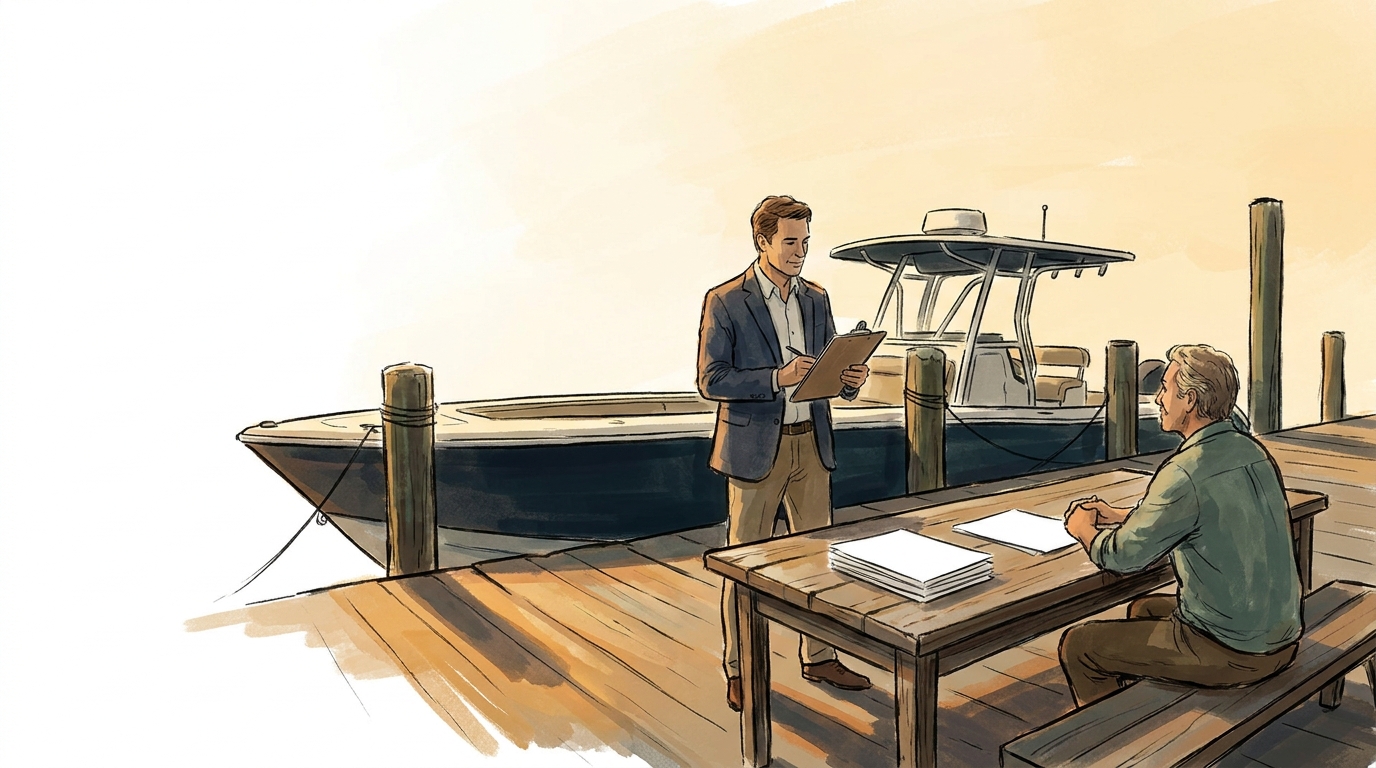
Scammers almost always create urgency — a "deployed military" story, a divorce, a relocation deadline. Legitimate sellers, and reputable brokerages like Worldwide Yacht Sales, expect due diligence and welcome sea trials, marine surveys, and title searches. If a seller frames those steps as insulting or unnecessary, that framing is the tell.
Common story patterns to recognize
- "I'm overseas and can't show the boat in person, but a shipping company will handle everything."
- "The boat is already in storage in another state — pay first, inspect on arrival."
- "Use this specific escrow service; it's the only one I trust."
- "I need a deposit today to hold it for you against other offers."
How do fake boat listings in Florida usually work?
Fake boat listings in Florida typically clone real photos from sold inventory, list the vessel at 15–30% below comparable market prices, and route buyers off-platform to email or text. The scammer then requests a wire transfer to a personal account or a spoofed escrow site, and disappears once funds clear — usually within 24 to 48 hours.
Fort Lauderdale, Miami, and the Florida Keys appear disproportionately in these listings because buyers nationwide expect Florida inventory, and shipping-from-Florida stories feel plausible. Reverse image searching the listing photos will often surface the original ad on a legitimate brokerage site, sometimes with a different price and a different seller name — that's your proof.
How do you verify a seller before sending money?
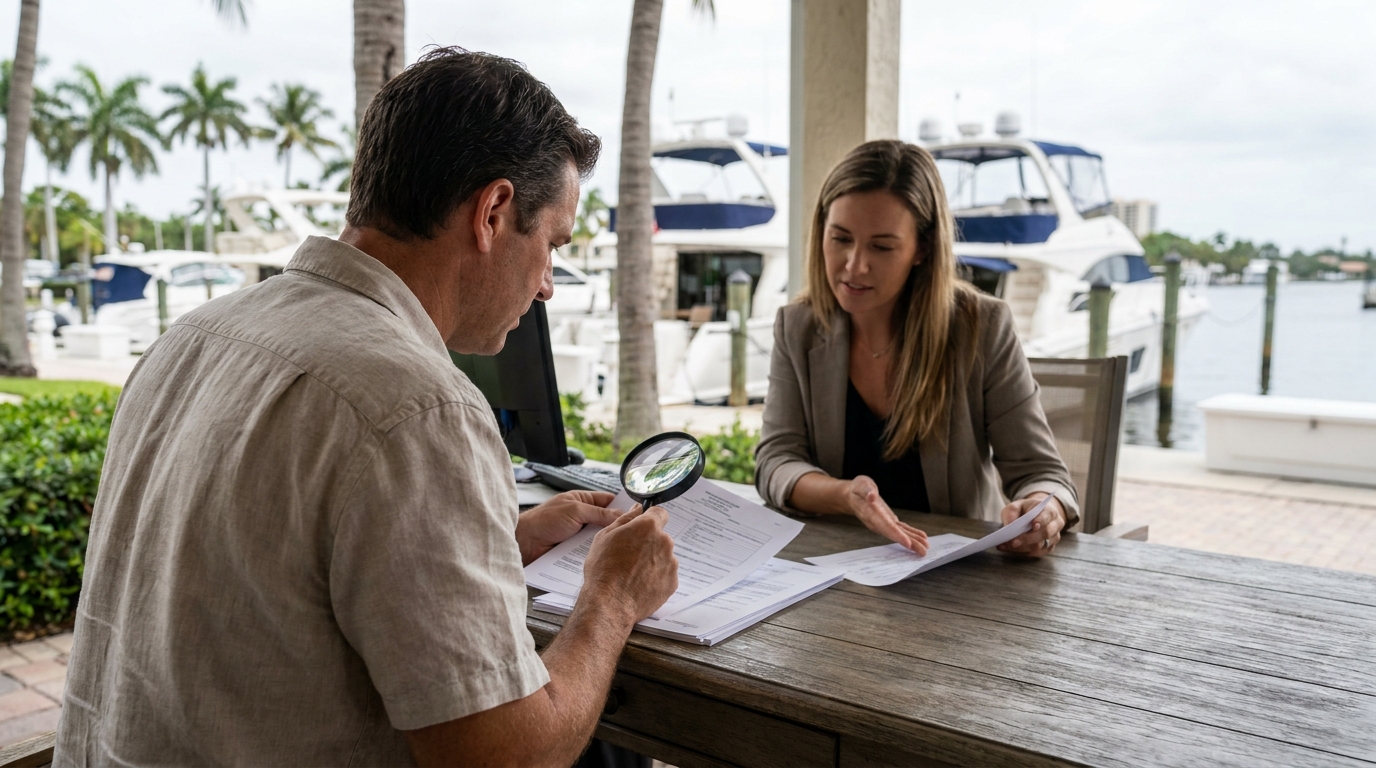
Verify a boat seller by confirming three things: (1) the individual or brokerage holds a current Florida Yacht and Ship Broker's license through the Department of Business and Professional Regulation, required for anyone selling vessels 32 feet or longer for compensation; (2) the HIN on the transom matches the title and USCG documentation; and (3) the seller will meet you at the boat's actual slip.
Florida requires yacht brokers handling qualifying vessels to maintain a bonded escrow account and a physical place of business — a searchable license record is a strong trust signal. Independent sellers aren't required to hold that license, but they should still produce a clean title, valid registration, and photo ID that matches the title's name.
The verification checklist
| Step | What to confirm | Where to check |
|---|---|---|
| Broker license | Active Florida Yacht & Ship Broker license | Florida DBPR license search |
| Vessel identity | HIN matches title and hull | USCG vessel documentation search |
| Title status | No liens, matches seller name | Florida FLHSMV title check |
| Physical location | Boat is at the stated marina | In-person visit or live video |
| Payment route | Licensed escrow, not personal wire | Verify escrow company independently |
| Survey | SAMS or NAMS accredited surveyor | SAMS.org or NAMSglobal.org directory |
Why does Fort Lauderdale see so many boat scams?
Fort Lauderdale sees elevated online boat sale fraud because the region hosts one of the world's densest concentrations of yacht inventory — the Fort Lauderdale International Boat Show alone brings hundreds of vessels to Bahia Mar each fall — and buyers nationwide search "Florida" as a proxy for legitimate stock. Scammers exploit that search behavior with cloned listings.
The market's geography compounds it. Buyers along the New River, Las Olas Isles, and up through Pompano Beach transact year-round, but activity spikes ahead of hurricane season in June and again during snowbird months from November through March. Fraudsters time listings to those windows, when out-of-state buyers are most likely to purchase remotely and least likely to visit the boat in person.
What payment methods are safe — and which are not?
Safe payment for a boat purchase means funds move through a licensed marine escrow service or a broker's bonded trust account, never directly to a seller's personal account. Wire transfers to individuals, cryptocurrency, gift cards, peer-to-peer apps like Zelle or Cash App, and "escrow" services the seller introduces are the payment channels most closely associated with fraud.
A legitimate closing on a documented vessel involves a bill of sale, a Coast Guard transfer of documentation or Florida title transfer, and payment released only after the survey and sea trial pass. Brokerages that handle the paperwork end-to-end — one recent Worldwide Yacht Sales customer described a Florida-to-Rhode Island purchase where the brokerage coordinated financing, inspection, and shipping — remove most of the touchpoints scammers exploit.
How does a marine survey protect you from fraud?
A marine survey by a SAMS- or NAMS-accredited surveyor confirms the boat physically exists at the stated location, matches its HIN and documentation, and is structurally what the listing claims. Because you hire and pay the surveyor directly, a scammer selling a boat that doesn't exist cannot fake this step — the surveyor's inability to locate the vessel exposes the fraud before closing.
Budget roughly $20 to $25 per foot for a pre-purchase survey in South Florida, plus haul-out fees at a local yard. It is the single most cost-effective fraud check available, and it doubles as the condition assessment your insurer and lender will require anyway.
What should you do if you've already sent money to a scammer?
If you've already wired funds, call your bank within minutes — not hours — and request a wire recall, then file reports with the FBI's Internet Crime Complaint Center (IC3.gov), the Florida Attorney General's office, and the Fort Lauderdale Police Department. Wire recalls sometimes succeed if initiated before the receiving bank releases the funds, typically within a 24-hour window.
Also notify the platform where the listing appeared so the account can be frozen before other buyers are targeted. Recovery odds drop sharply after 48 hours, which is why the verification steps above matter more than any after-the-fact remedy.
Frequently asked questions
Is it safe to buy a boat remotely without seeing it in person?
Yes, remote boat purchases are safe when handled through a licensed brokerage that coordinates a local surveyor, an accredited escrow, and documented shipping. The risk isn't distance — it's skipping verification. Worldwide Yacht Sales holds a 4.8-star rating across 28 Google reviews, with customers specifically praising remote transactions where the boat arrived in the condition described.
How do I check if a Florida yacht broker is licensed?
Search the Florida Department of Business and Professional Regulation (DBPR) license database at MyFloridaLicense.com. Yacht and ship brokers selling vessels 32 feet and longer for compensation are required to hold an active license and maintain a bonded escrow account. If a broker's name doesn't appear in the DBPR search — or the license is inactive — treat that as a stop signal.
What is a HIN and where do I find it?
A Hull Identification Number (HIN) is a 12-character code required on all boats built after 1972, permanently affixed to the starboard side of the transom and often duplicated in a hidden secondary location. It must match the title, registration, and Coast Guard documentation exactly. Any discrepancy — altered digits, mismatched paperwork, or a missing HIN — indicates a stolen or misrepresented vessel.
Should I use the escrow service the seller recommends?
No. Choose escrow independently, verify it exists through its state licensing regulator, and call the escrow company using a phone number you found yourself — never one the seller supplied. Fake escrow websites are a signature of online boat sale fraud; they mirror real company branding closely enough to fool a quick glance but route funds to the scammer.
How much below market is "too good to be true" for a boat?
Anything priced 20% or more below comparable listings on BoatTrader, YachtWorld, or similar platforms warrants heightened scrutiny. Legitimate motivated sellers exist, but they will still meet you at the boat, allow a survey, and use standard payment channels. Deep discounts combined with any of the red flags above — remote seller, wire-only payment, urgency — almost always indicate fraud.
Does title insurance exist for boats?
Yes, marine title insurance is available for documented vessels and is worth considering on higher-value purchases. It protects against undisclosed liens, ownership disputes, and fraudulent transfers discovered after closing. A title search through the U.S. Coast Guard's vessel documentation system will surface most issues before you close, but insurance covers the gaps a search can miss.
The bottom line
Online boat sale fraud is preventable at the verification stage — after money moves, options narrow fast. The buyers who get burned almost always skipped one of three steps: broker license verification, in-person or independently-surveyed inspection, or licensed escrow. The buyers who don't get burned treat those three steps as non-negotiable, whether the boat is in Fort Lauderdale or being shipped from it.
Readers in Fort Lauderdale, FL who want a boat purchase handled through a licensed brokerage — with surveyor coordination, escrow, and documentation managed end-to-end — can reach Worldwide Yacht Sales at https://worldwideyachtsalesinc.com to walk through the process before making an offer on any vessel.